AI Writing Policies at Work: How Strong Teams Govern AI-Assisted Content
- →The question is no longer whether teams use AI. Microsoft and LinkedIn found 75% of knowledge workers already do, so the real job is governing it well.
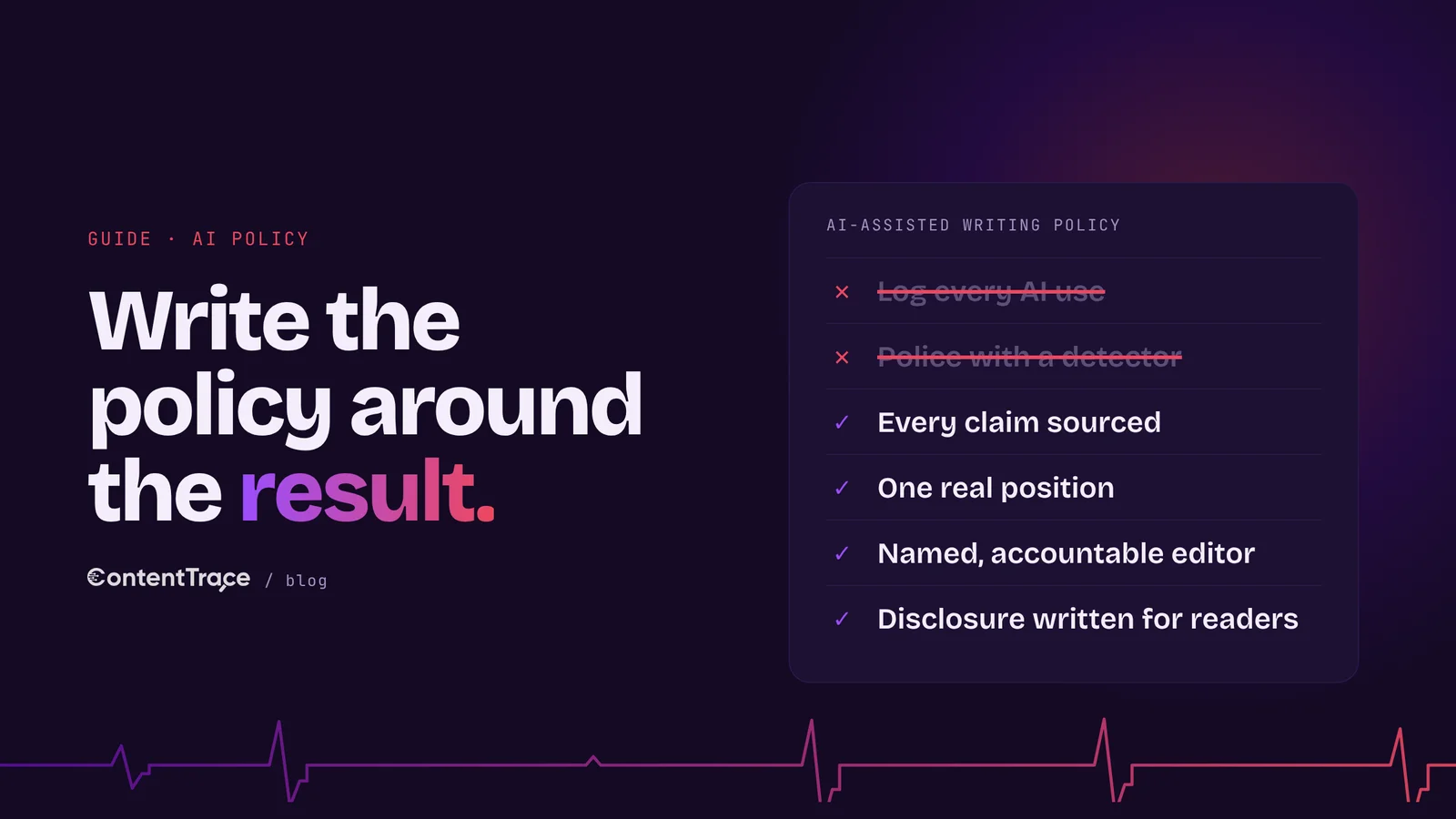
- →Policies built on process (log every AI use, prove you disclosed) create compliance theater and get enforced with unreliable detectors.
- →Policies built on output (sourced claims, a real position, a named accountable editor) can be checked by reading the piece, whoever or whatever drafted it.
- →Disclosure belongs in the policy as a note for readers, following Google's Who, How and Why guidance. It fails as a policing tool.
- →A writing score works inside review as a diagnostic that shows where the human contribution is thin. It should never be a verdict on a person.
In May 2024, Microsoft and LinkedIn surveyed 31,000 people across 31 countries for their Work Trend Index. Three in four knowledge workers said they already used AI at work. More telling: 78% of those AI users were bringing their own tools, without waiting for the company to pick one.
That number ended the "should AI be allowed?" debate for most content teams. Not by policy. By practice. People started drafting with AI, results were mixed, and organizations found they needed real governance instead of a blanket yes or no.
Getting that governance right is harder than it looks. The obvious policy moves (disclosure forms, AI-use logs, output limits) tend to produce compliance theater rather than better writing. The teams that use AI well got there through a different frame entirely. They stopped governing the tool and started governing the result.
Microsoft and LinkedIn 2024 Work Trend Index. A ban doesn't stop that use. It only hides it from review.
Why process-based policies mostly fail
The most common policy looks like this: disclose when AI was used, get approval for AI-generated content above a certain length, log usage in a shared doc. On paper it's reasonable. In practice it breaks in several places.
Enforcement is the first crack. If enforcement depends on catching people who didn't disclose, it depends on detectors, and detectors make mistakes that land on real people. A 2023 Stanford study by Weixin Liang and colleagues ran essays by non-native English writers through seven popular GPT detectors. More than half were misclassified as AI-generated, with an average false positive rate of 61.22%. Writers who put serious work into a draft get flagged. Writers who use AI lightly but cleverly don't. Everyone on the team learns that the mechanism is unreliable, usually within a month.
The definition is the second crack. Does "AI-generated" include using AI to research? To restructure an outline? To suggest a better word? To write a first draft that was then mostly rewritten? Anyone who uses these tools daily has done all of that in a single piece. A policy that doesn't answer the question will be applied differently by every person who reads it.
The third problem matters most. Process rules measure the wrong thing. What decides quality isn't whether AI touched the draft. It's whether the published piece shows real expertise, specific knowledge and editorial judgment. A policy that records the process and says nothing about the output is auditing the kitchen and never tasting the food.
What output-focused policies look like
A sourcing standard
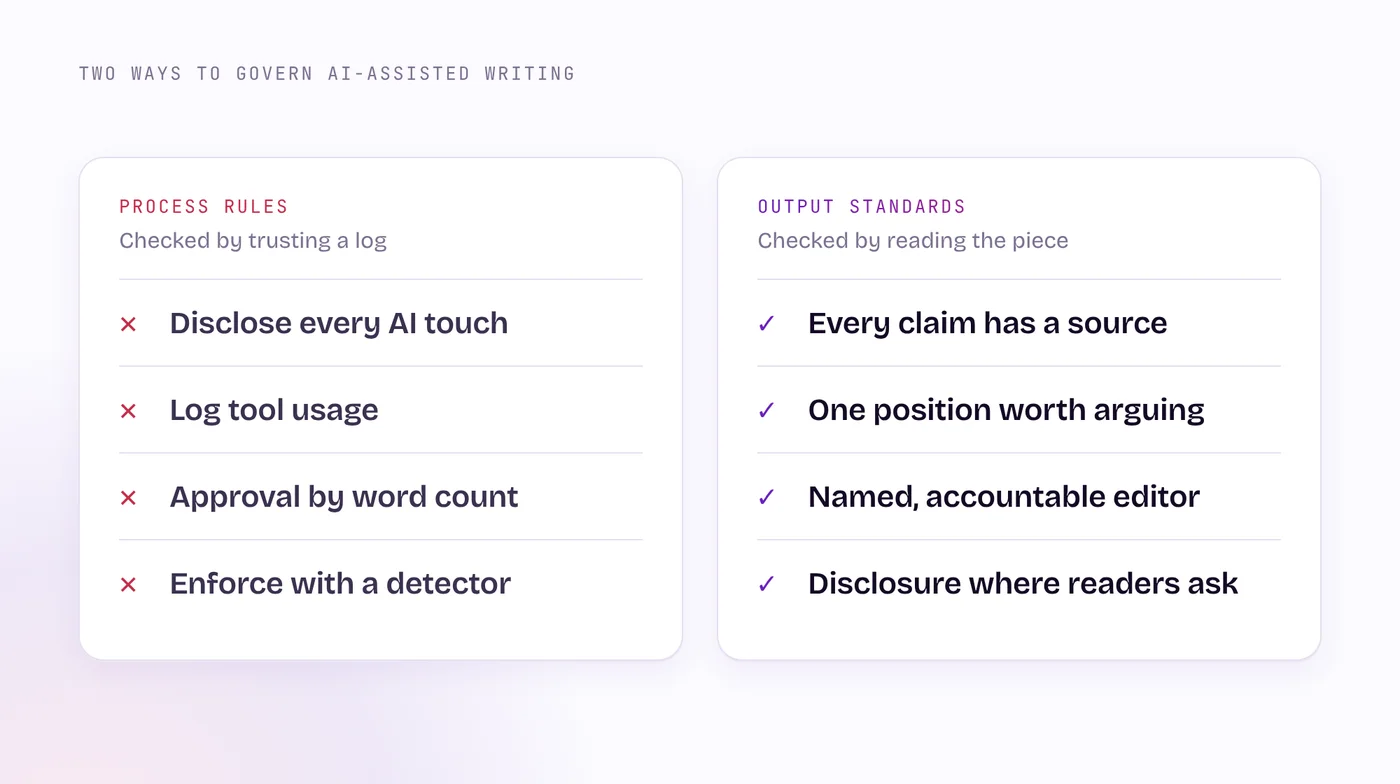
The most workable standard is a sourcing rule: every specific factual claim needs a named, linkable source. Not "research suggests." A study, a date, a URL that someone on the team actually opened. This doesn't restrict AI use at all. It requires the editorial work of checking and attributing what the draft claims, and that work is exactly what separates strong AI-assisted content from the hollow kind.
The bonus is that it's auditable after the fact. Nobody needs to know whether AI was used. Anyone can open the piece and see whether the claims are sourced.
A take requirement
Some teams use a version of what one editor called "the take requirement": every external piece must contain at least one real position that someone could disagree with. Not a summary of existing views. A claim the author is willing to put their name on.
Raw AI output almost never meets this bar, because models avoid positions that could be wrong. They hedge, balance and present several perspectives. The take requirement forces the judgment a model can't supply, and that judgment is visible in the published text.
An accountable editor
The teams that have figured this out treat AI as producing a draft, not content. The draft goes through a required editorial step where a named person (accountable for the result, not just signing off on it) adds the sourcing, the position and the first-hand knowledge only they can provide. The AI draft isn't a shortcut around that step. It's the starting point for it.
That differs from "have a human review it before publishing." Review implies checking for errors and approving. An accountable editor contributes, and leaves a visible trace of their thinking in the piece. That difference separates content that performs from content that merely seems adequate.
Disclosure that works: written for readers, not for compliance
None of this means disclosure is a bad idea. It means disclosure is a bad enforcement tool. As a promise to readers, it's good practice.
Google's guidance on helpful content frames it well. It asks publishers to think about "Who, How, and Why": make the author clear, explain how the content was made, and be honest about why it exists. One of its self-assessment questions asks whether "the use of automation, including AI-generation" is self-evident to visitors through disclosures or in other ways. The suggestion is to add a note where readers might reasonably ask how something was created.
The obvious fix, then, is to require a disclosure line on every piece that AI touched. It doesn't work, because "touched" covers everything from a spell check to a full draft, and a label on every page tells readers nothing. A better rule is shorter: disclose where a reader would want to know, describe what the AI did in plain words, and keep a named human byline on the final version. That disclosure protects trust. The internal log mostly protects the person who wrote the policy.
Here's the surprising part. The writers who do the most real editing on top of AI drafts are often the most willing to disclose, because they know the finished piece holds up. Resistance to disclosure is usually a sign that the edit was thin, which is a quality problem wearing a compliance costume.
"A policy that records the process and says nothing about the output is auditing the kitchen and never tasting the food."Content Trace · Voice & Perspective Signal
Where a writing score fits in the review step
The most useful internal use of a writing score is diagnostic, never punitive. Teams run a draft through a tool like Content Trace before final review. Not to catch anyone breaking a rule. To see where the editorial layer is thin.
That only works if the reviewer reads the section breakdown instead of the headline number. Content Trace explains its score with 32 signals in 8 sections. A draft can read well on Word Choice and Structure & Flow and still sit low on Voice & Perspective and Cognitive Fingerprinting. That pattern says something specific: the surface was polished, but the thinking underneath is still the model's. The fix is a position or a real example, not another pass of word swaps. A single overall number can't tell a reviewer that.
One rule keeps this healthy. The score informs the editor. It never decides anything about the writer. Any team that uses a score to accuse someone has rebuilt the detector problem from the first section, just with nicer charts.
The cultural piece nobody wants to talk about
Policy can set a standard. It can't create the thing that actually produces good AI-assisted content: a team that takes the gap between efficiently produced and actually useful seriously. Teams that publish consistently strong work share an assumption that the AI part is easy (a draft takes minutes) and the human part is the job. The policy reflects that, and so does the review calendar.
Teams that struggle have quietly absorbed the opposite belief: that AI made content production easy and the human step is overhead. It shows in the output. It shows in the morale too. Few things in a content team land worse than a writer who spent two days on a piece, did the interviews, checked every source, and then got asked to "explain the AI score" in a Slack thread. That specific mix of insult and exhaustion is what process-first policies produce, and it's why good writers leave them.
Use AI. Write the policy around the result. Hold the bar where readers would hold it.
Frequently asked questions
For the editing side of the accountable-editor step, How to Humanize AI Content lays out six passes, and The Specificity Test shows how to check a draft for real detail. AI Detection in Education covers what goes wrong when scores are used as verdicts, and AI Detection and SEO explains how Google treats AI-assisted pages.
Colin H builds ContentTrace at Web Thrive. He has spent 20+ years in B2B SaaS marketing, running content, SEO and AEO programs, and now builds them around AI-assisted content production. Read the ContentTrace manifesto