Can AI Detectors Be Fooled? What the Research Actually Shows
- →Yes, AI detectors can be fooled. Published research shows paraphrasing tools push many detectors close to chance.
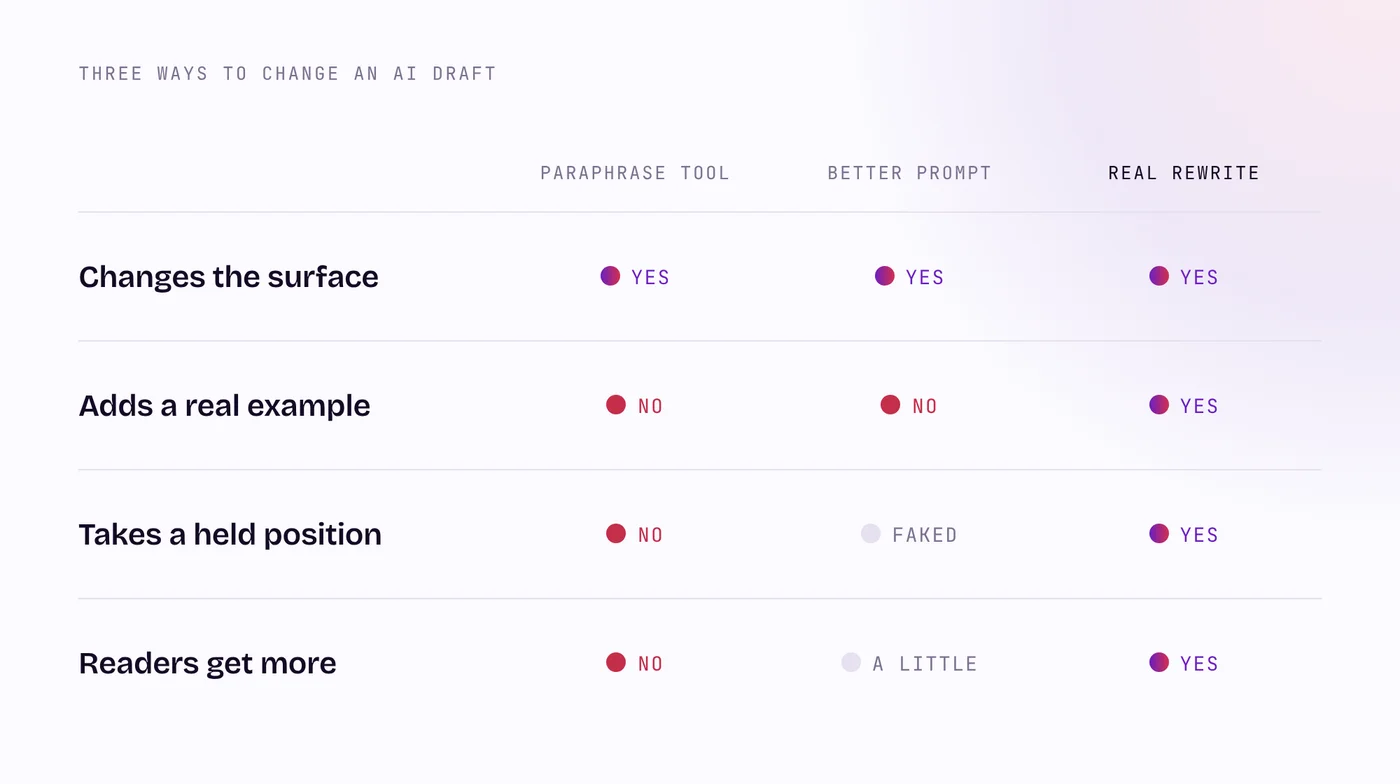
- →Bypass tools change the statistical surface of a text. They don't add a real example, a held opinion or any knowledge the draft lacked.
- →Fooling a detector is the wrong goal. A draft that passes a scanner can still bore every reader who opens it.
- →The one technique that reliably moves a score is real rewriting, which is also the only one that makes the writing better.
- →Treat any score, from any tool, as a pointer to what still needs editing. It's a poor verdict and a useful diagnostic.
In 2023, a team led by Kalpesh Krishna fed AI-generated text through a paraphrasing model they built, called DIPPER. Before the rewrite, the detector DetectGPT caught 70.3% of the AI text at a 1% false positive rate. After it, the detector caught 4.6%. One rewrite pass, and a detector that worked most of the time became close to blind.
That's the honest answer to the question in the title. AI detectors can be fooled, and the research says so plainly. There's a whole corner of the internet built on that fact: Reddit threads, YouTube walkthroughs and paid tools that promise "undetectable" output. Pretending they all fail would be dishonest, and it wouldn't help anyone make a real decision about their content.
The more useful question comes next. If the trick works, what did it actually change? And is passing a scanner something worth wanting in the first place? This post takes a firm position on the second question: no. Fooling a detector is the wrong goal. The right goal is a piece of writing that readers finish.
From Weber-Wulff et al. (2023). Unedited AI text was classified correctly 74% of the time.
What bypass tools are actually attacking
Most bypass tools target statistical features. The classic one is perplexity: given the words before it, how surprising is the next word? Language models pick likely continuations at every step, so raw AI output tends to be predictable in ways human writing isn't. Bypass tools add noise. They swap words for synonyms, reorder clauses and vary sentence lengths on purpose, so the text looks less predictable on paper.
Against detectors built mostly on those statistics, this works. The largest independent test of the period, by Debora Weber-Wulff and seven co-authors, ran 14 detection tools against 54 documents. Unedited AI text was classified correctly 74% of the time on average. Manually edited AI text fell to 42%. Machine-paraphrased AI text fell to 26%. The authors called the tools "neither accurate nor reliable."
Here's the surprising part of that data. The paraphrasing machine did better at evasion than the human editors did. A person making real edits changed the text less, in the detectors' eyes, than software that understood nothing about the topic. That tells you what most of those detectors were measuring, which was surface statistics. Even the companies building models struggled here. OpenAI withdrew its own AI text classifier in July 2023 "due to its low rate of accuracy"; at launch it had correctly flagged only 26% of AI-written text.
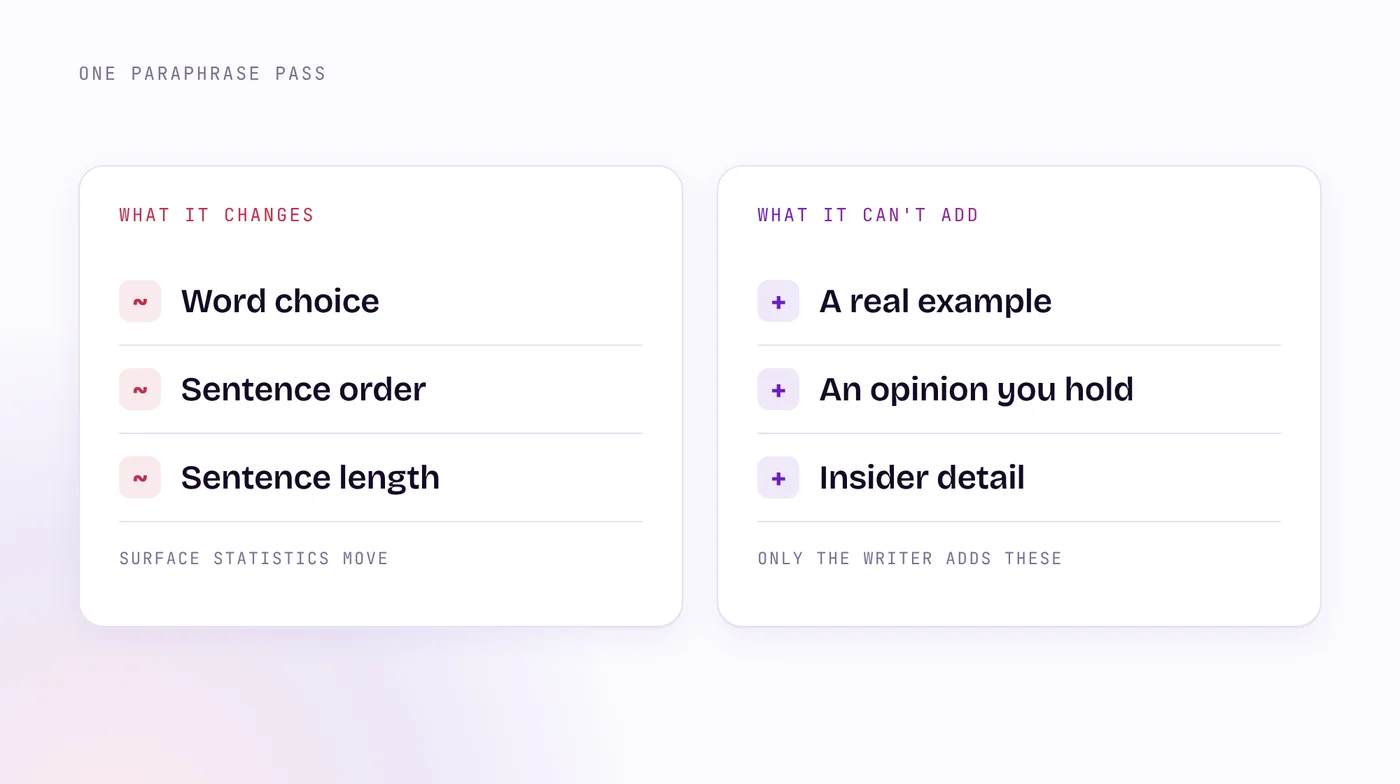
And the substance is exactly what a paraphraser leaves alone. Take a hypothetical AI draft about churn reduction that says "businesses should focus on customer engagement." After a paraphrase pass it says "organizations ought to prioritize client interaction." The score may drop. The sentence is still empty. Nobody learned anything new in either version.
The techniques, ranked honestly
Paraphrasing tools: effective against the wrong target
Paraphrasers do one job, which is changing the statistical surface. The score drops because the job gets done. Two problems follow. Aggressive paraphrasing often makes the writing worse, with stiff synonyms and constructions that are grammatical but strange. And the reader was never the target. A careful reader flags the edit marks even when the detector doesn't.
The obvious fix is to paraphrase, then clean up the awkward bits by hand. It doesn't solve anything, because the cleanup only polishes the surface again. The draft still has no example a reader would remember. You end up with smoother emptiness, which is a strange thing to spend an afternoon producing.
Prompt engineering: better than post-hoc, still limited
Prompting the model to "use a conversational tone, vary sentence lengths, add specific examples" produces somewhat more natural output than a bare prompt. That much is fair.
There's a ceiling, though. The anecdotes a model produces on request are built, not remembered. They fit the point they illustrate perfectly, with no stray detail and no friction. The model's position holds steady from the first paragraph to the last, because it picked a thesis and executed it. Ask it to fake a change of mind and it will, usually in the same place and with the same rhetorical move every time. That regularity becomes a pattern of its own.
Actual rewriting: the bypass that proves the point
The most effective technique by a long way is real editing. Take the AI draft and rewrite it: add an opinion from your own experience, cut the sections you don't believe, put in a specific memory, reorder the argument because the model got the logic backwards.
That draft reads as human because a human shaped it. Nothing was gamed. There's something satisfying in that. The bypass that works best is the one where you do the work of writing, and it's the only one that leaves the piece better than it found it.
Why fooling a detector is the wrong goal
Think about who the "undetectable" pitch is for. A detector score has no readers. It doesn't buy anything, share anything or come back next week. People do, and people don't run your post through GPTZero before deciding whether to keep reading. They decide in the first few paragraphs, based on whether the writing tells them something they didn't already know.
Search engines don't reward disguise either. Google's guidance on helpful content asks whether a page offers "original information, reporting, research, or analysis" and whether it shows "first-hand expertise." It also asks publishers to be open about how automation was used. Hiding the AI won't answer any of those questions. A paraphrased draft that adds nothing is still a page that adds nothing.
There's a real frustration behind the bypass market, and it deserves respect. Writers get false positives on work they wrote themselves, and that feels awful: you did the work and a number says you didn't. But the answer to a bad verdict is to stop treating scores as verdicts. Hiding from the scanner fixes nothing.
"You can't paraphrase your way into an opinion you don't hold. You can only shuffle the words around the one you borrowed."Content Trace · Voice & Perspective Signal
Why a multi-section breakdown is harder to game
A tool that returns a single number is easy to beat, because you only need to move one number. A breakdown that looks at many separate qualities of the text asks a harder question. Paraphrasing moves vocabulary and rhythm. Prompting nudges tone. Neither one adds a real example, a held position or the kind of detail only someone inside a field would know.
That's why Content Trace explains its results with 32 signals in 8 sections, instead of a single verdict. The aim is to show the writer which parts of a draft are still generic, so the next edit goes where it matters. A breakdown is only useful to someone trying to improve the piece. To someone trying to hide, it's just more numbers to fight.
What a middle-band score actually means
A score in the middle of a tool's range used to look like a detection failure, the tool unable to decide. That reading is wrong. A middle score usually means the text really is mixed, and the tool is reporting that honestly.
It could be an AI-assisted draft where the writer added real material in some sections and not others. It could be a human writer with a formal, even style (academic and legal writing often scores as more AI-like than casual writing, even when it's entirely original). It could be a document stitched from several sources. The number alone can't tell you which.
The sections can. A draft that is fine on rhythm but weak on point of view needs a different edit than one with strong opinions and no specifics. Look at the breakdown, find the weakest part and fix that. Then the score is doing its proper job, which is telling you where to work next.
Frequently asked questions
For the editing work that actually moves a draft, How to Humanize AI Content lays out six passes in order. The 8 Signals That Give AI Writing Away covers the patterns no paraphraser can supply. And Why Your AI Detector Score Keeps Changing explains why scores from different tools rarely agree.
- Krishna et al. (2023): Paraphrasing evades detectors of AI-generated text, but retrieval is an effective defense (arXiv)
- Weber-Wulff et al. (2023): Testing of detection tools for AI-generated text, International Journal for Educational Integrity
- OpenAI: New AI classifier for indicating AI-written text (withdrawn July 2023 for low accuracy)
- Google Search Central: Creating helpful, reliable, people-first content
Colin H builds ContentTrace at Web Thrive. He has spent 20+ years in B2B SaaS marketing, running content, SEO and AEO programs, and now builds them around AI-assisted content production. Read the ContentTrace manifesto