The Specificity Test: The Detail That Makes Writing Memorable
- →The fastest test for a generic draft is to look for specific, inconvenient detail, the kind that doesn't fully serve the argument but could only come from someone who was there.
- →AI drafts optimize for illustrative clarity. Every example fits the point exactly, and that tidiness is what makes them forgettable.
- →Concrete text is easier to understand, more interesting and better remembered. A 2000 study in the Journal of Educational Psychology found concreteness was the best predictor of all three.
- →Fake precision, like an unsourced "73% of marketers", is worse than honest vagueness, because it implies research that never happened.
- →The test is an editing tool. Use it on your own AI-assisted drafts to find exactly where a real detail needs to go.
In a study published in the Journal of Educational Psychology in 2000, Mark Sadoski, Ernest Goetz and Maximo Rodriguez had undergraduates read four kinds of text: persuasive essays, expository passages, literary stories and narratives. Across all of them, concrete text was recalled better than abstract text. The authors called concreteness "overwhelmingly the best predictor" of how understandable, interesting and memorable a passage was.
That finding is twenty-six years old. It explains almost everything wrong with the average AI draft.
AI writing is rarely wrong. It's comprehensive, accurate and covers a topic from several reasonable angles. It is also almost entirely generic, and the genericness has a texture an experienced editor learns to spot in a paragraph or two. The examples are too perfect. The anecdotes are too illustrative. The numbers are either missing or suspiciously round.
The cause is structural. A language model writes by predicting what comes next from patterns in its training data. When it needs an example, it reaches for the most representative one: the example that best fits the pattern of "example that supports this kind of claim." A person does the opposite. A person asks what actually happened, in a project, a report or a case they read closely, and writes that down.
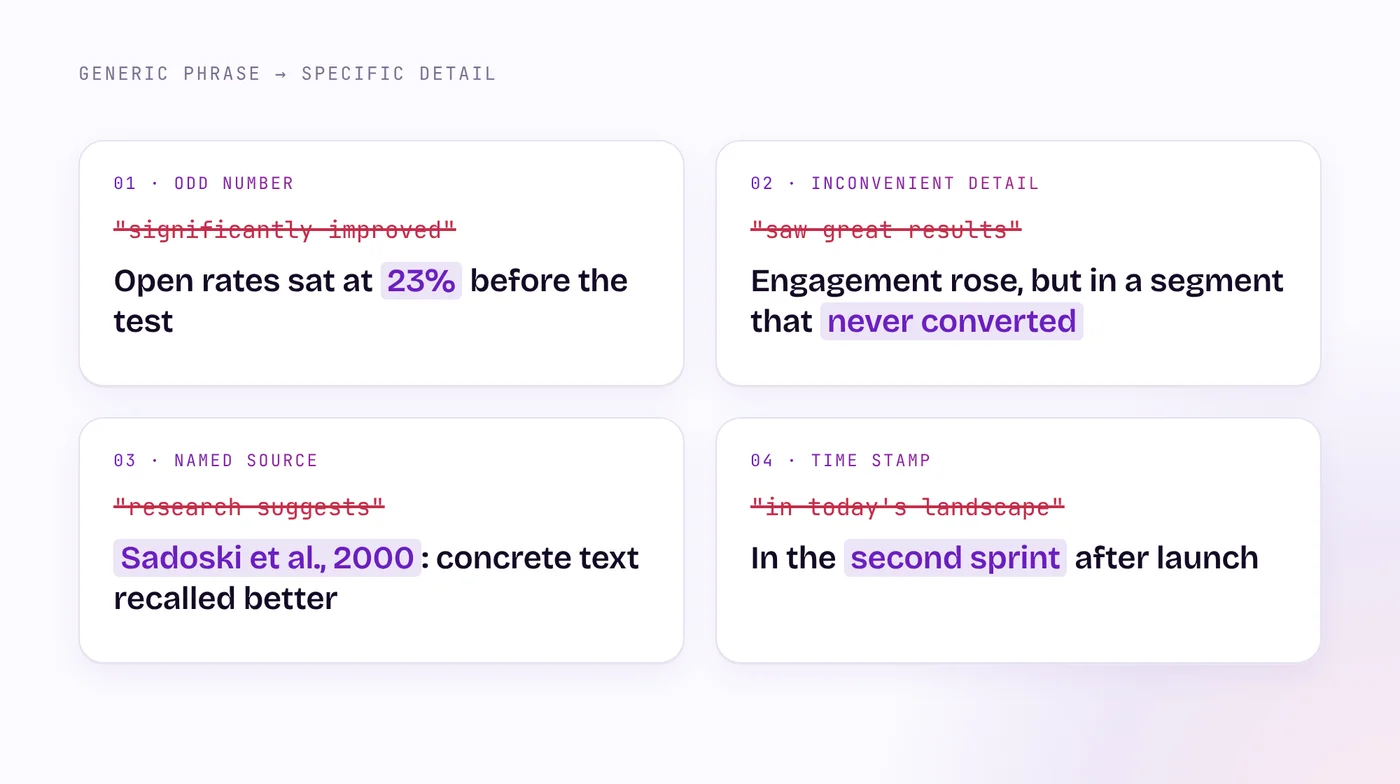
Odd numbers, inconvenient details, named sources and time stamps. Each one is evidence that a person was there.
Why illustrative clarity is a warning sign
The clearest mark of a generated example is illustrative clarity: the example fits the point so perfectly that it couldn't have come from real experience. Real memories don't behave that way. Real projects are messy. The outcome was more complicated than the lesson, and the detail that sticks is usually the one that doesn't quite serve the argument.
Take two hypothetical versions of the same story. Version one: "A content team implemented an AI review process and saw quality scores improve significantly over the following quarter." It happened, it worked, it proved the point. Version two: "A B2B SaaS team publishing about 12 articles a month added a human review step for voice and sourcing. Two months later quality was up. Output was down, which started its own argument, and it's still not clear they'd make the same call again."
The second version is harder to read. The lesson is less clean. There's tension that never resolves. That's what writing from memory looks like, and readers notice it even when they can't say why. Careful editors notice it too, and so do the voice and logic signals in tools like Content Trace.
The four marks of authentic specificity
Numbers that are oddly precise
People who ran the report remember the actual number. "Open rates were sitting at 23% when the subject line test started" beats "open rates in a typical range." Odd precision is a trace of real measurement: somebody looked at a dashboard and the number stuck.
AI drafts go one of two ways. Either vague quantities ("significantly improved", "a substantial share") or confident figures ("70% of marketers report...") that nobody can source. Both read differently from a real data point someone actually looked at.
Details that don't fully serve the argument
This is the mark that shows up most in strong human writing. Some detail is there because it's true, and the writer couldn't leave it out. A caveat that complicates the takeaway. A follow-up thought that weakens the previous claim a little. An aside that's interesting and slightly off topic.
AI drafts don't do this. Every detail earns its place by supporting the point, and the structure is efficient in a way human thinking never is. When every element fits together too neatly, the piece reads as assembled rather than remembered.
Named sources and exact attribution
Real research produces named citations: the study, the authors, the year, a link. "Research suggests" is doing a lot of unpaid work in most AI drafts. Models tend to cite the shape of evidence ("studies show", "experts agree") because they reproduce how claims are usually supported, not because they recall a specific source. A named, linkable citation is a strong sign that someone did the research, or at least did the editorial work of checking it.
Time and place stamps
Real events happen on a date, in a tool version, in a specific meeting. "After the March pricing change" or "in the second sprint after launch" anchors a claim in time. Generic drafts float in an eternal present where everything is "today's landscape" and nothing ever happened on a Tuesday.
Fake precision is worse than vagueness
One failure mode deserves its own name: content that looks specific and isn't. Statistics without sources, quotes nobody can verify, and case studies vague enough to describe any company in any industry, all dressed up as evidence.
The obvious fix for a generic draft is to tell the model to "add specific examples and data." It doesn't work, because the model has no access to your data. It produces numbers that look measured (a 37% lift, a 4.2x return) and case studies with tidy arcs. The draft gets more specific on the surface and less true underneath. That's the surprising part: the most confident-looking number in a draft is often the one most likely to be invented.
Any editor who has chased one of those figures knows the feeling. It's a particular sinking frustration, twenty minutes into searching for the source of a perfect-looking statistic, when it becomes clear there never was one. Honest vagueness at least doesn't pretend. Fake precision implies sourcing that doesn't exist, and readers who catch it stop trusting everything else on the page.
"The most confident-looking number in an AI draft is often the one most likely to be invented."Content Trace · Content & Logic Signal
Using the specificity test on your own drafts
The useful thing about this test is that it works on your own writing first. Before publishing an AI-assisted draft, read it once with a single question: could this sentence appear, unchanged, in a competitor's article? Mark every example that's too clean, every number sourced to "industry data", every case study that could describe anyone. Those marks are the to-do list.
The additions don't need to be dramatic. A date. A named source you actually opened. A complicating detail from a real project. The admission that an approach didn't work at first. Small intrusions of real experience are what make content worth reading, and they line up with what search engines ask for. Google's guidance on helpful content asks whether a page provides "original information, reporting, research, or analysis" and whether it shows first-hand expertise. Specific detail is the visible proof of both.
There's something almost elegant in that overlap. The details that make writing memorable to a reader are the same details that move a Content Trace report toward human, section by section. Which suggests the best use of any writing score has little to do with judging other people's work. It's a fast way to see what your own draft is still missing.
Frequently asked questions
For a full editing workflow built around this idea, How to Humanize AI Content puts specificity at pass three of six. Why AI Writing Sounds Different covers the patterns behind generic drafts, and AI Detection and SEO explains how Google treats AI-assisted pages.
Colin H builds ContentTrace at Web Thrive. He has spent 20+ years in B2B SaaS marketing, running content, SEO and AEO programs, and now builds them around AI-assisted content production. Read the ContentTrace manifesto