AI Detection in Education: What Schools Are Getting Wrong
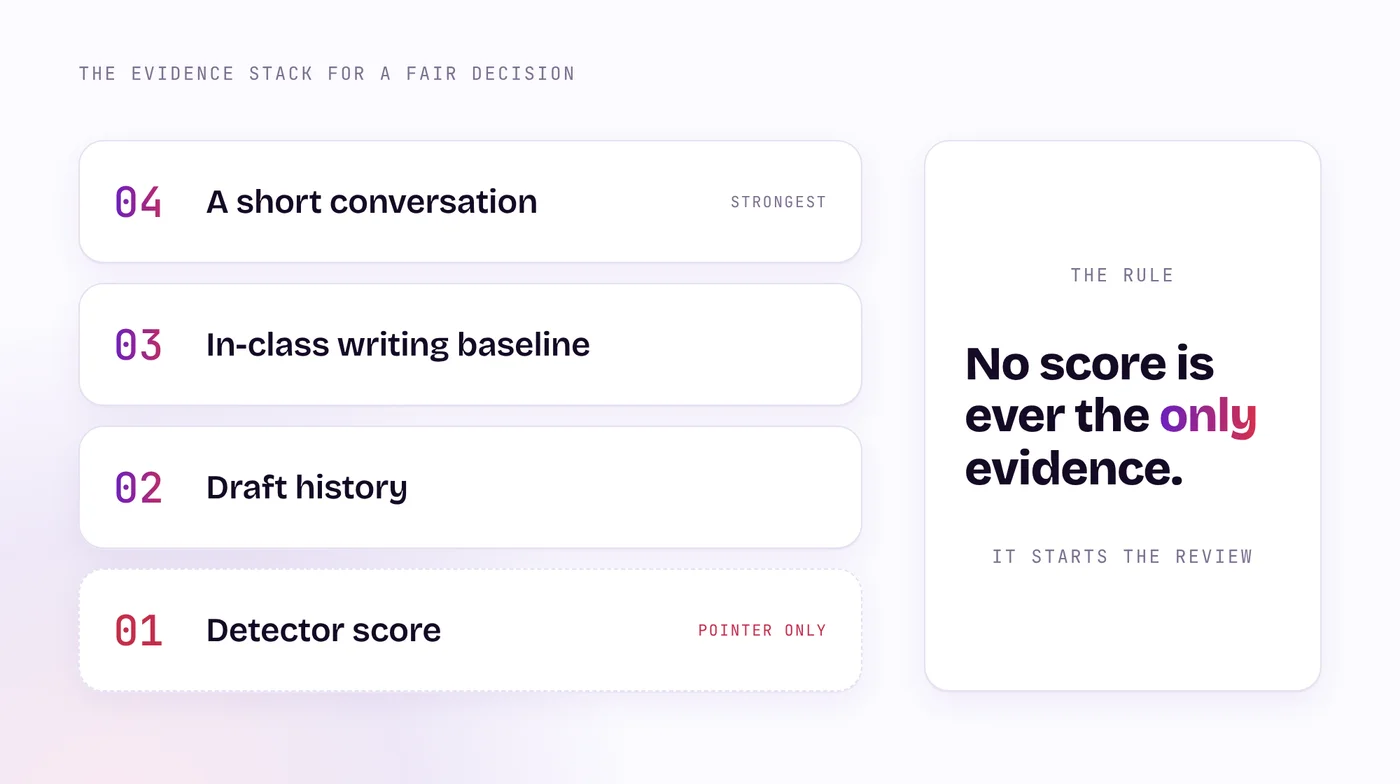
- →A detector score is never the only evidence about a student. Even Turnitin says its AI result should not be the sole basis for action.
- →Non-native English writers get flagged far more often. One Stanford study found 61.22% of TOEFL essays labeled AI-generated on average.
- →Teachers aren't the problem. They were handed confident tools in a hurry, with no time added to their week to use them carefully.
- →The most useful evidence is what the teacher already knows: class discussion, earlier work, and whether the student can explain the argument.
- →A good policy uses the score to start a short conversation and never to skip one.
In August 2023, Vanderbilt University switched off Turnitin's AI detector. Its reasoning was simple arithmetic. Turnitin had claimed a 1% false positive rate, and Vanderbilt had submitted about 75,000 papers to Turnitin in 2022. At 1%, that's roughly 750 student papers that could have been wrongly labeled as AI-written in a single year.
Seven hundred and fifty students, each facing an accusation for work they wrote themselves. That's the scale problem in one number, and it's why this post takes a clear position: a detector score must never be the only evidence about a person.
That position needs one careful qualifier up front. Criticizing how detectors are used is not a defense of cheating. Students passing off AI-generated work as their own is a real problem, and teachers who worry about it are right to. The question is whether current practice works, or whether it creates new harms while mostly missing the original one.
Across seven detectors, in Liang et al. (2023). The same tools labeled 5.19% of US eighth-grade essays that way.
The false positive problem is documented
The students who get flagged by mistake aren't random. In 2023, Weixin Liang and colleagues at Stanford ran seven widely used detectors on 91 TOEFL essays written by people. On average the detectors labeled 61.22% of them AI-generated. On 88 essays by US eighth graders, the rate was 5.19%.
The cause is how many detectors work. People writing carefully in a second language tend to pick safer, more common words and simpler sentence shapes, and many detectors treat that predictability as a sign of a machine. The same study found something stranger. When the researchers simplified the word choices in the native eighth-grade essays, the misclassification rate jumped to 56.65%. Plain vocabulary alone was enough to look like AI.
That's a structural problem with using detectors as judges. A tool deployed to catch cheating that lands hardest on students already working in a second language isn't doing the job it was bought for.
A score is never the only evidence
Here's the core mistake. A number like "93% AI" gets treated as a finding of fact, and then the student has to argue against a probability. The vendors don't claim that role for their tools. Turnitin's own guide says the AI writing result "should not be used as the sole basis for adverse actions against a student," and its blog on false positives says Turnitin "does not make a determination of misconduct."
There's an insider detail in the same guide that few instructors ever see. Turnitin needs at least 300 words of prose to produce a result at all, and for scores between 1% and 20% it shows an asterisk, because its testing found "a higher incidence of false positives" in that range. The tool is warning the reader in small print. Most readers never get to the small print.
"[The AI writing result] should not be used as the sole basis for adverse actions against a student."Turnitin · AI writing detection guide
A probability is a reason to look closer, and nothing more. Think of a weather forecast: 90% chance of rain is a good reason to take an umbrella and a bad reason to sue the sky. In an integrity case, a bad outcome means a mark on a student's record, and the feeling on the other side of that is easy to picture. A student who wrote every word, sitting in a meeting, trying to prove a negative.
Be fair to teachers
It would be easy to make teachers the villains here. That's wrong, and it misses where the problem sits. AI writing arrived in classrooms almost overnight. Detectors arrived soon after, often switched on at the institution level with little notice (Vanderbilt notes Turnitin enabled its feature with less than 24 hours' warning). Nobody added hours to a teacher's week to go with it.
The impulse to lean on a number makes sense under those conditions. Grading is exhausting. Classes are large. A score feels cleaner than a judgment call, and it's easier to point to in a hearing, which is a different virtue from being right.
And teachers hold the one thing no tool has: a baseline. A teacher who has read a student's work all semester knows how that student argues, which examples they reach for and what they said in class last Tuesday. If an essay matches none of that, the mismatch is real evidence, whatever any detector says. The best policies put that knowledge back at the center, and then give teachers the time to use it.
The signal that holds up: evidence of thinking
The working assumption used to be that a better detector would settle this. It won't, because the useful signal was never in the statistics. What actually separates a student's writing from a pasted AI draft is evidence of thinking. Real student writing has friction: ideas that almost land, an argument that gets corrected mid-paragraph, a sentence that doesn't work followed by one that nearly does.
Raw AI output is smooth in a way that gives it away. The structure is too clean, every claim gets a neatly weighted counterpoint, and nothing is ever unresolved. People work through a hard question with false starts. A model spreads probability across the expected moves and calls it an essay.
What better practice looks like
Some schools ask for drafts alongside the final work, with a short process note on how the thinking changed. That's hard to fake well. A model can produce a draft and a final, but the student still has to explain how their own reasoning moved, and that explanation is revealing.
Others use brief oral follow-ups on major assignments. Not a twenty-minute defense. Five minutes and two or three questions: "Talk through how this argument developed." "Why this source and not the one from week four?" A student who wrote the essay can usually answer. The evidence is direct, and no probability is involved.
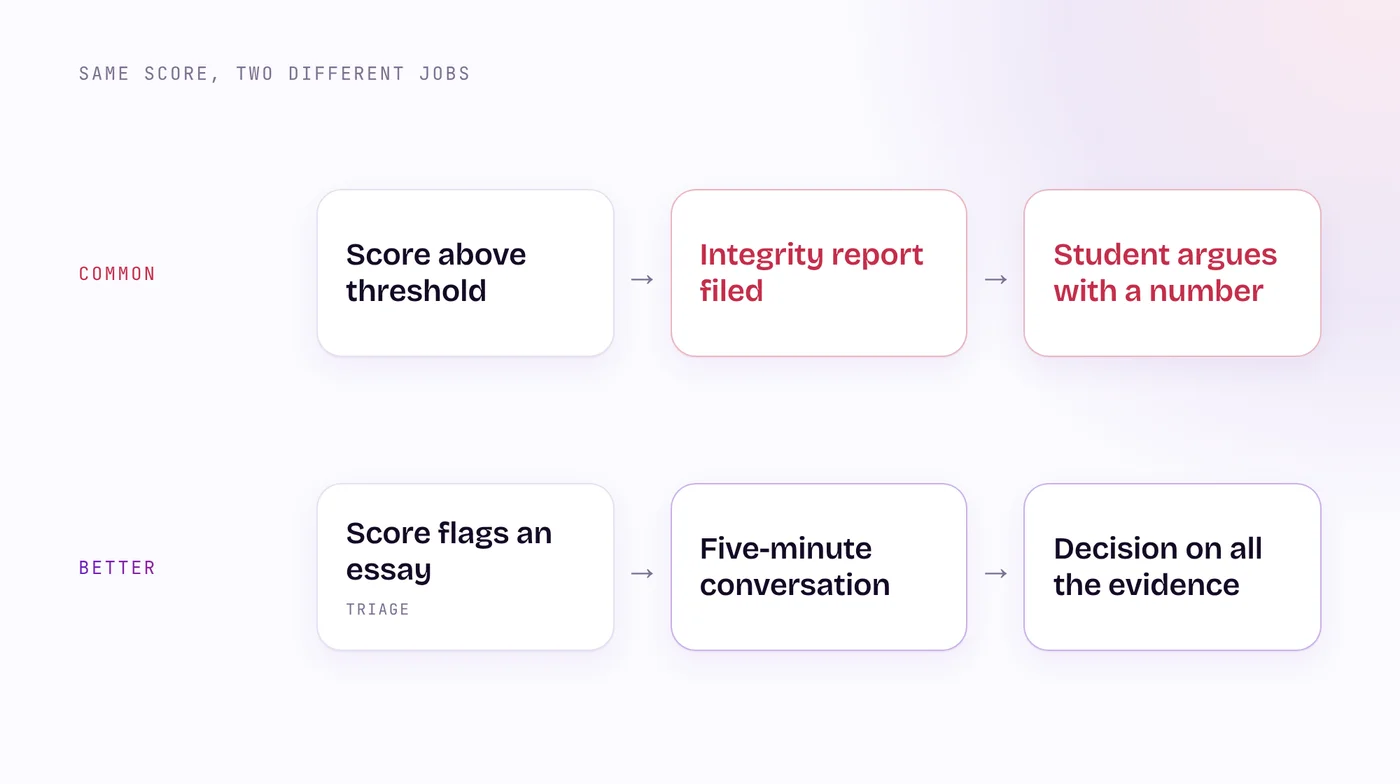
These approaches cost teacher time, and that's a real limit at scale. So the honest version of the policy uses the score for triage: it decides which five essays get the five-minute conversation, out of a stack of ninety. That's a job a probabilistic tool can do. Deciding guilt isn't.
Where this lands
AI detection in education is worth doing as triage. It's harmful as an automated judge. A breakdown that shows a polished essay with no visible thinking doesn't prove a student cheated. It tells a teacher where to ask a question.
Schools that adopted "score above X means an integrity charge" are using probabilistic tools in a way their own vendors warn against, and real students are paying for it. The fix sits at the policy level: openness with students about which tools are used, a rule that no score is ever the only evidence, and enough time for teachers to have the conversations the score points to. Tools like Content Trace explain their results with 32 signals in 8 sections for exactly this reason. A breakdown gives a reader something to discuss, where a bare number only gives them something to accept or reject.
Frequently asked questions
For what these tools measure under the hood, see How AI Text Detection Actually Works. Why Your AI Detector Score Keeps Changing explains why two tools rarely agree on the same essay. And How to Read a Detection Report covers what to look at beyond the headline number.
- Liang et al. (2023): GPT detectors are biased against non-native English writers (arXiv)
- Turnitin Guides: AI writing detection
- Turnitin: Understanding false positives within our AI writing detection capabilities
- Vanderbilt University: Guidance on AI detection and why we're disabling Turnitin's AI detector (August 2023)
- Weber-Wulff et al. (2023): Testing of detection tools for AI-generated text, International Journal for Educational Integrity
Colin H builds ContentTrace at Web Thrive. He has spent 20+ years in B2B SaaS marketing, running content, SEO and AEO programs, and now builds them around AI-assisted content production. Read the ContentTrace manifesto