Why AI Writing Sounds Different (Even When It's Technically Correct)
- →AI drafts are technically correct but feel hollow because they carry no evidence of a mind working through a problem.
- →Readers are bad at labeling AI text and good at tuning it out. The cost shows up as skimming and forgetting, rarely as a complaint.
- →Reflexive hedging ("it's worth noting", "it's important to consider") is one of the clearest tells. People hedge when they're unsure. AI drafts hedge everywhere.
- →Rhythm gives a draft away faster than vocabulary, but readers judge rhythm against meaning. A raw sentence-length statistic misses what they hear.
- →Invented specifics are too clean. Real ones are slightly awkward, and that imperfect fit is what makes them feel true.
- →Every one of these gaps can be closed in the edit, which is the whole case for AI-assisted writing done well.
An editor at Web Thrive was once handed a page of writing and asked whether anything felt off. She read it for maybe thirty seconds, handed it back, and said: "Nobody wrote this." She couldn't explain exactly why. She was right.
The page was grammatically clean, factually accurate and logically structured. By any technical measure it was fine. Yet something was missing, something she spotted instantly without being able to name it. This post is an attempt to name it, and to connect it to what ordinary readers notice when they meet an unedited AI draft.
Clark et al., 2021. Readers can't label AI text well, yet they still feel when nobody is home.
Writing is a record of thinking, not a container for information
When a person writes, they aren't just moving information from their head to the page. They're thinking on the page. The act of writing changes what they think. Sentences get abandoned halfway because a better version appeared. Paragraphs end somewhere different from where they started, because the argument moved while it was being made.
A raw AI draft doesn't work that way. The model generates toward a conclusion that was implicit in the prompt before the first word appeared. What looks like reasoning is pattern completion. The texture of real thought, tentative and self-correcting and sometimes surprised by where it lands, is missing. Not weakened. Missing.
That's why an AI draft can be technically perfect and still feel hollow. It has all the information. It lacks evidence of a mind at work.
What readers actually notice (and what they don't)
Here's the surprising part. People are poor at labeling AI text. In a 2021 University of Washington study, untrained evaluators separated GPT-3 writing from human writing at roughly chance level across stories, news and recipes. Three different training methods pushed accuracy to 55% at most.
So the editor's thirty-second call is unusual. Most readers never think "a model wrote this." They think "this is a bit dull," or they think nothing at all and move on. The reaction is behavioral. They skim, they stop scrolling, they don't share it. The page passes through them without leaving a mark.
Readers do pick up certain words, though, and those words have become a running joke. A 2024 analysis of more than 15 million PubMed abstracts by Kobak and colleagues found that "delves" appeared about 28 times more often in 2024 than the earlier trend predicted. "Underscores" and "showcasing" jumped too. The authors estimate that at least 13.5% of 2024 abstracts were processed with an LLM. Somewhere, a biologist who has said "delve" all her life is now being side-eyed by reviewers.
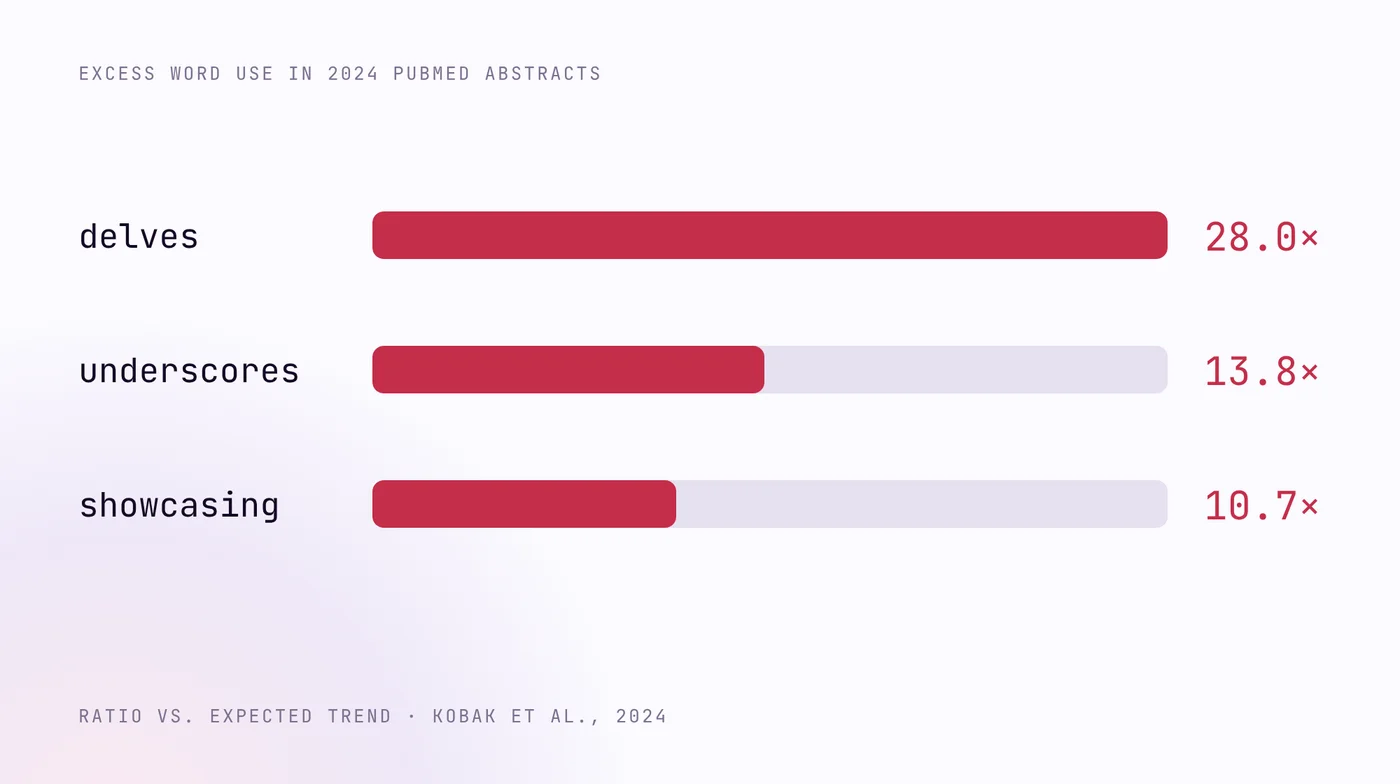
Vocabulary is the easy part, and the least important. Swap every "delve" for "dig into" and the draft still reads as nobody's. The deeper patterns below are what readers respond to without noticing.
The hedging problem is worse than people realize
Pick one signal that most reliably marks a raw AI draft and reflexive hedging is a strong candidate. "It's important to note." "It's worth considering." "There are several factors at play here." "This is a complex topic with many dimensions."
People hedge too, but strategically, when they really are unsure. AI drafts hedge constantly, whether or not uncertainty is warranted. The hedge signals carefulness without being careful. The result qualifies everything and commits to nothing, and readers experience it as evasive even when they can't say why.
One habit from Web Thrive editing work: a quick Ctrl+F for "it's worth" before reading anything else. The count is usually embarrassing. Four or five in a thousand-word draft isn't a stylistic quirk. It's a tell.
Rhythm gives it away faster than vocabulary
Read a paragraph of raw AI output aloud. Then read something from a writer you love. The difference in rhythm is usually immediate. You don't need to analyze it. You feel it in your mouth.
Human writers vary sentence length a lot. A short sentence lands. Then something longer unfolds, carrying the reader through a harder idea at a pace that matches it. Then another short one, to reset. Most of this isn't deliberate. It's what happens when you write the way you think, and thinking has bursts and pauses built in.
AI drafts tend to be metronomic. Sentences cluster around one length, paragraphs come out the same size, and the cadence stays even in a way real thought never does. In prose, smooth is another word for forgettable.
The tempting conclusion is that sentence-length variance, often called burstiness, should be a reliable tell. It isn't, at least as a number. In ContentTrace internal testing on October 3, 2026, burstiness separated human and AI text no better than chance, so it's now shown in reports for reference only, with no weight. Readers don't hear variance. They hear whether a short sentence lands on the point that deserves it. A statistic can't tell an emphatic short sentence from a random one.
"AI writing rarely changes its mind. Human writing almost always does, even when the writer doesn't notice it happening."Content Trace · Cognitive Fingerprinting Signal
The specificity gap, and why invented details feel wrong
Human writers reach for specifics. Not "a major city" but "Cincinnati." Not "a well-known study" but "Kahneman and Tversky's 1979 prospect theory paper." Not "many users reported problems" but something like "eleven beta testers flagged the same bug in the first week."
Those specifics do two jobs at once. They make the writing credible, because they suggest the writer knows the subject. And they make it personal, because they anchor the content to something that happened rather than a constructed illustration.
Google's guidance for creators asks the same question in plainer terms. Its self-assessment list includes whether content provides "original information, reporting, research, or analysis" and whether it shows "first-hand expertise and a depth of knowledge." A specific detail is the cheapest way to answer yes.
AI drafts reach for illustrative generalities because the model has no experiences to draw from. It can invent specifics, but invented specifics have a different texture. They're too clean, too perfectly on point. Real specifics are slightly awkward. A real example is the right example, though maybe not the most elegant one, and that imperfect fit is part of what makes it feel true.
How this shows up in a Content Trace report
The Content & Logic section, 13% of the default weight, covers Insider/Niche Knowledge, Surprising Observations and related signals. You can run a draft through Content Trace and see how it scores signal by signal. If Content & Logic is the lowest section, the specificity gap is usually what's showing up.
What the editor was actually sensing
In those thirty seconds, the editor most likely picked up the combined absence of all these things. No change in rhythm where the meaning changed. No opinion that shifted mid-paragraph. No detail that felt accidentally true. No hedge earned by real doubt. No sign of a person working something out in real time.
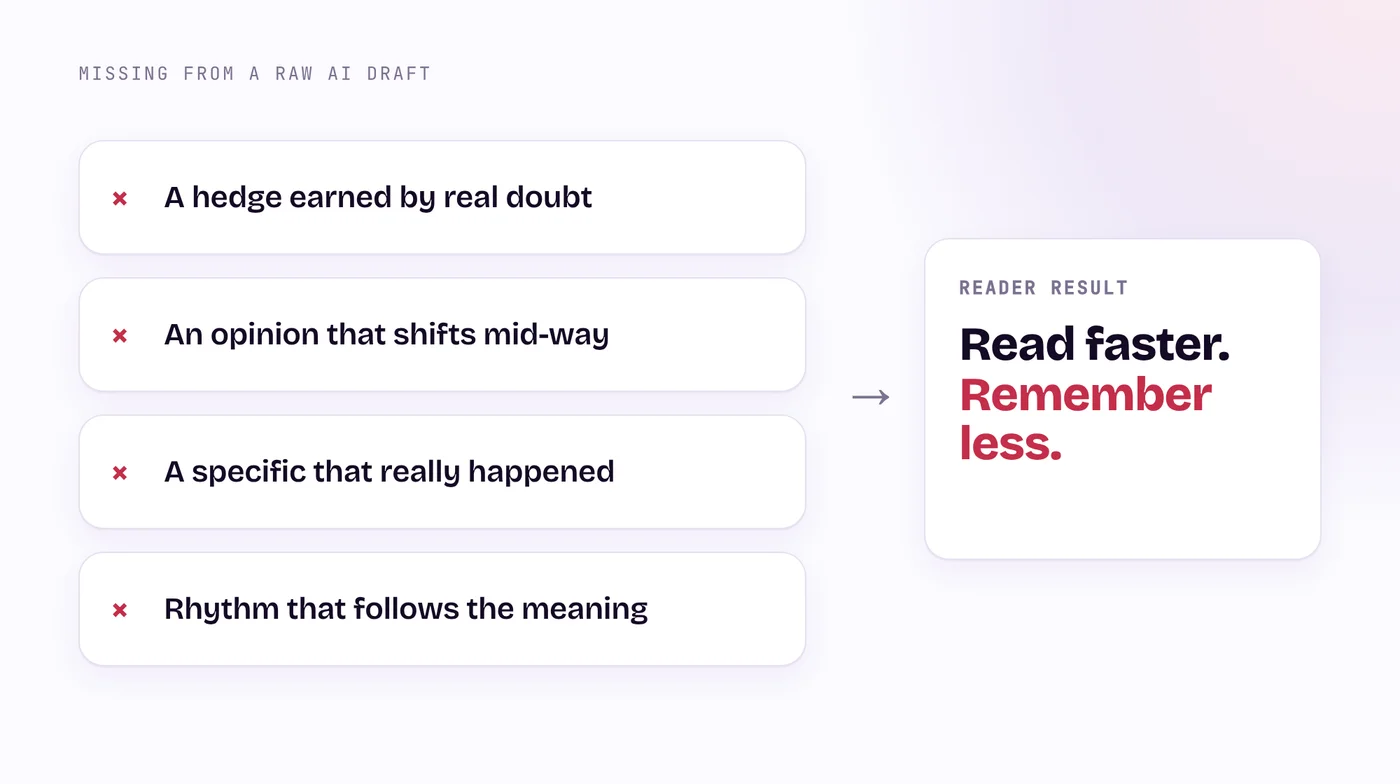
The writing wasn't wrong. It just wasn't from anywhere. It didn't come from a mind that had spent time with the subject, formed a view, changed that view slightly while writing it down and made peace with the imperfect result. Readers feel that absence even when they can't name it.
That's the real cost of an AI draft published as is. Accuracy is rarely the problem. The page is simply forgettable, and forgettable pages don't get read twice. And the frustrating part, for anyone who has watched a well-researched page earn zero shares, is that the fix was available the whole time: an edit that adds the opinion, the specific and the doubt. AI can do the first draft. The person whose name goes on it has to supply the rest.
Frequently asked questions
For the mechanics behind these signals, How AI Text Detection Actually Works compares perplexity, classifiers and rubric-based reading. The Behavioral Signals That Give AI Writing Away walks through each signal with examples. And Can AI Detectors Be Fooled? covers why surface edits alone rarely change how a draft reads.
Colin H builds ContentTrace at Web Thrive. He has spent 20+ years in B2B SaaS marketing, running content, SEO and AEO programs, and now builds them around AI-assisted content production. Read the ContentTrace manifesto