How to Humanize AI Content: A Practical Guide
- →Humanizing AI content has nothing to do with tricking detectors. The goal is writing good enough to be worth someone's time.
- →The filler-phrase pass (cutting "it's worth noting", "it's important to", "in today's landscape") always comes first.
- →Reading aloud is the fastest way to find rhythm problems. Wherever your voice wants to speed up or slow down, the sentence needs work.
- →Every "for instance, imagine a..." example should become something that was actually witnessed, measured or lived.
- →Every draft contains at least one claim worth disagreeing with. Find it and rewrite that section to say what you actually think.
- →Content Trace section scores work as a diagnostic. A low Cognitive Fingerprinting score means the draft still has too little real thinking in it.
Last year, one content team seen up close during a Web Thrive engagement published forty blog posts in a single month. AI drafts, light edits. Traffic climbed for about six weeks because the keywords were right. Then it went flat. People clicked, read two paragraphs and left. Time on page was bad. Newsletter signups from all forty posts came to roughly zero.
That pattern repeats more often than most teams want to admit. AI content can win on volume and early discovery. It almost never wins the thing that builds an audience, which is the feeling that you just read something worth your time.
So, to be clear from the start: humanizing AI content is about making the writing good. Fooling a detector is a side effect at best, and a bad goal on its own. The framework below came out of a lot of trial and error. Mostly error, if the record is honest.
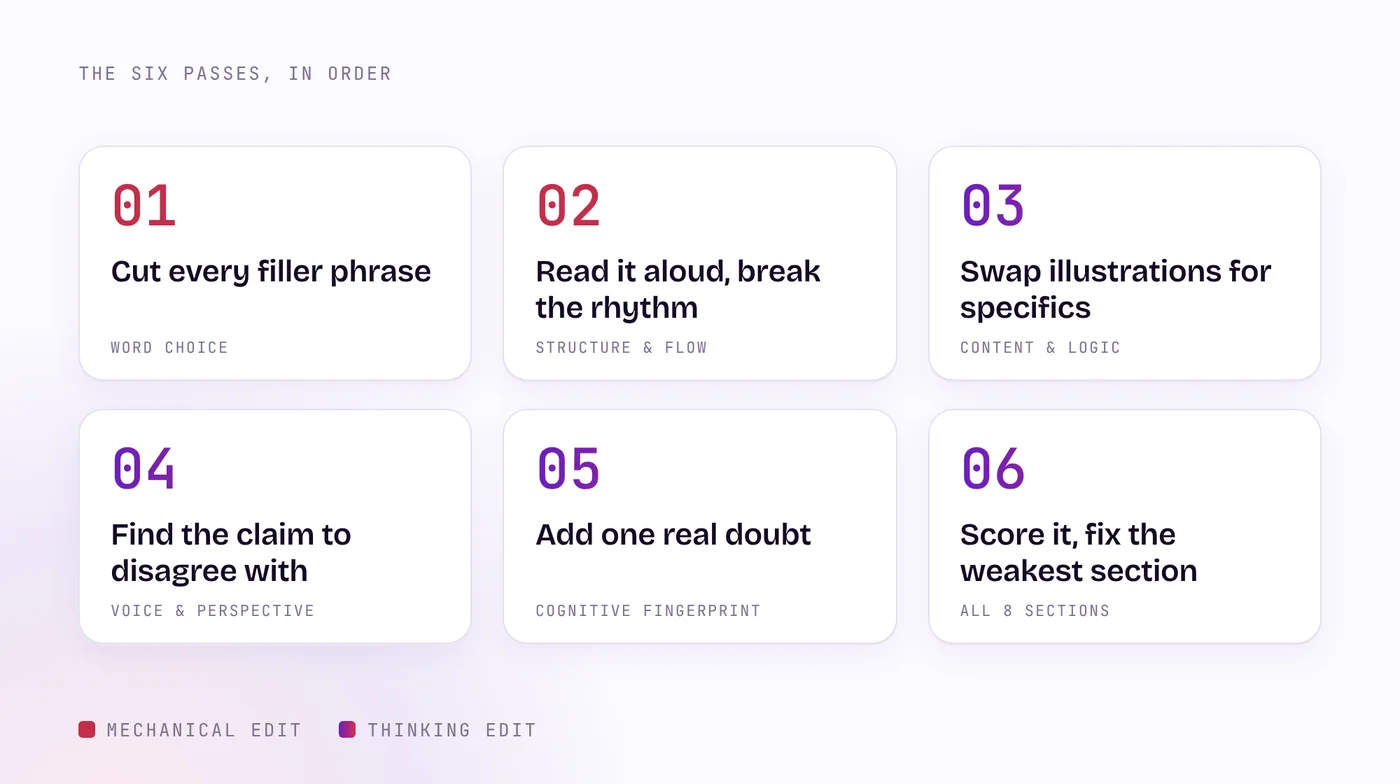
Each pass targets a different set of Content Trace signals. The order matters.
Pass 1: Kill every filler phrase before touching anything else
Before anything substantive, do one pass with one job: delete AI filler. These phrases signal carefulness without being careful. The full list is longer than you'd expect. The worst offenders are "it's important to note," "it's worth mentioning," "in today's rapidly changing landscape," "there are several key factors to consider," "in conclusion," "it goes without saying," and "needless to say" (which is always followed by something the writer felt badly needed saying).
All of them go. If a sentence falls apart without its filler phrase, the point underneath wasn't strong enough, so rewrite it or cut it. A good idea has never died in a filler cut. Plenty of weak ones have been exposed by it.
Pass 2: Read it aloud and break the rhythm
AI drafts read fine in your head. Out loud, the problem shows up in seconds. Every sentence is about the same length. Every paragraph is about the same size. It sounds like a legal disclaimer read by someone who has never had a strong feeling about anything.
Read the draft aloud and mark every spot where your voice wants to speed up or slow down. Speeding up means the sentence runs too long, so split it. Slowing down means the idea needs more room. A three-word sentence after a long one does more work than a paragraph of transitions.
Short sentences aren't the goal. Unpredictable ones are. Two long sentences, then a very short one. A medium paragraph, then a one-line paragraph. Then something long again. People write this way without trying, because they write at the pace of their own thinking, and thinking doesn't keep time like a metronome.
Pass 3: Replace every illustration with a specific
AI loves illustrative examples. "For instance, a small business might..." "Consider a scenario where..." "Imagine a user who..." They're tidy, serviceable and instantly forgettable, because they exist to make a point rather than to report something true.
Swap them for real specifics. A client from your own work (anonymized if needed). A number pulled from a real source. Something you saw happen, even briefly. The example doesn't need to be dramatic. It needs to have happened.
Readers can feel the difference between an invented illustration and a real event. Nobody has a clean explanation for why. The best guess is the slightly awkward fit of a real example, the way it never slots in as neatly as a made-up one. Invented examples are too helpful. Real ones have a little friction.
"Invented examples are too helpful. Real ones have a little friction, and that friction is what makes them feel true."Content Trace · Content & Logic Signal
Pass 4: Find the one thing you actually disagree with
This is the pass most people skip, and it matters most. AI drafts are balanced to a fault. They lay out several perspectives, acknowledge complexity and refuse to commit. That works for an encyclopedia entry. For anything meant to be read and remembered, it's fatal.
Go through the draft and find the claim you don't fully buy. Or the framing that feels a little wrong. Or the conclusion that's defensible on paper but isn't what you'd say to a colleague over coffee. Rewrite that section to say what you really think, including why the common take misses something.
Contrarian for its own sake is a pose. A point of view is a requirement. If you agree with every line on the first read, the read wasn't careful enough. Something is always slightly off: a priority flipped, a caveat given too much weight, a conclusion that's technically true and still misleading. Find it.
Pass 5: Add one moment of real uncertainty
AI writing is confident in a way that should make readers suspicious. It never says "this part is unclear" or "this was a surprise" or "the opposite view might still be right." That unbroken confidence is one of the clearest tells. Confidence isn't the problem. Real expertise just tends to come with a sharper sense of where its knowledge ends.
Add one place where the piece is honest about a limit or a doubt. Not performed humility. Actual uncertainty about something real. Maybe the data behind part of a claim is thin. Maybe your own experience runs against the consensus you just cited. Maybe the same approach has worked and failed in front of you, and the difference still isn't clear.
Readers trust writing more when it admits what it doesn't know. Everything else in the piece gets more credible, not less. The unearned confidence of AI text is a big part of why it feels hollow. Most readers never notice it consciously. They just sense that it doesn't match how people actually know things.
A note on what "real" means here
Some writers add fake uncertainty as a technique: "Of course, this could be wrong" dropped into an argument the writer is obviously sure about. That's the performed humility from above, and it reads as manipulative. The doubt has to be real. And if every line in the draft is something you believe without any doubt at all, the draft may be covering ground you know too well. That's useful to know too.
Pass 6: Score it, find the weak sections, iterate
After a full run through the framework, the piece goes into Content Trace. The point isn't to see whether it "passes" some threshold. That framing is wrong from the start. The point is to see which sections still score low, because those sections show exactly where the edit stopped short.
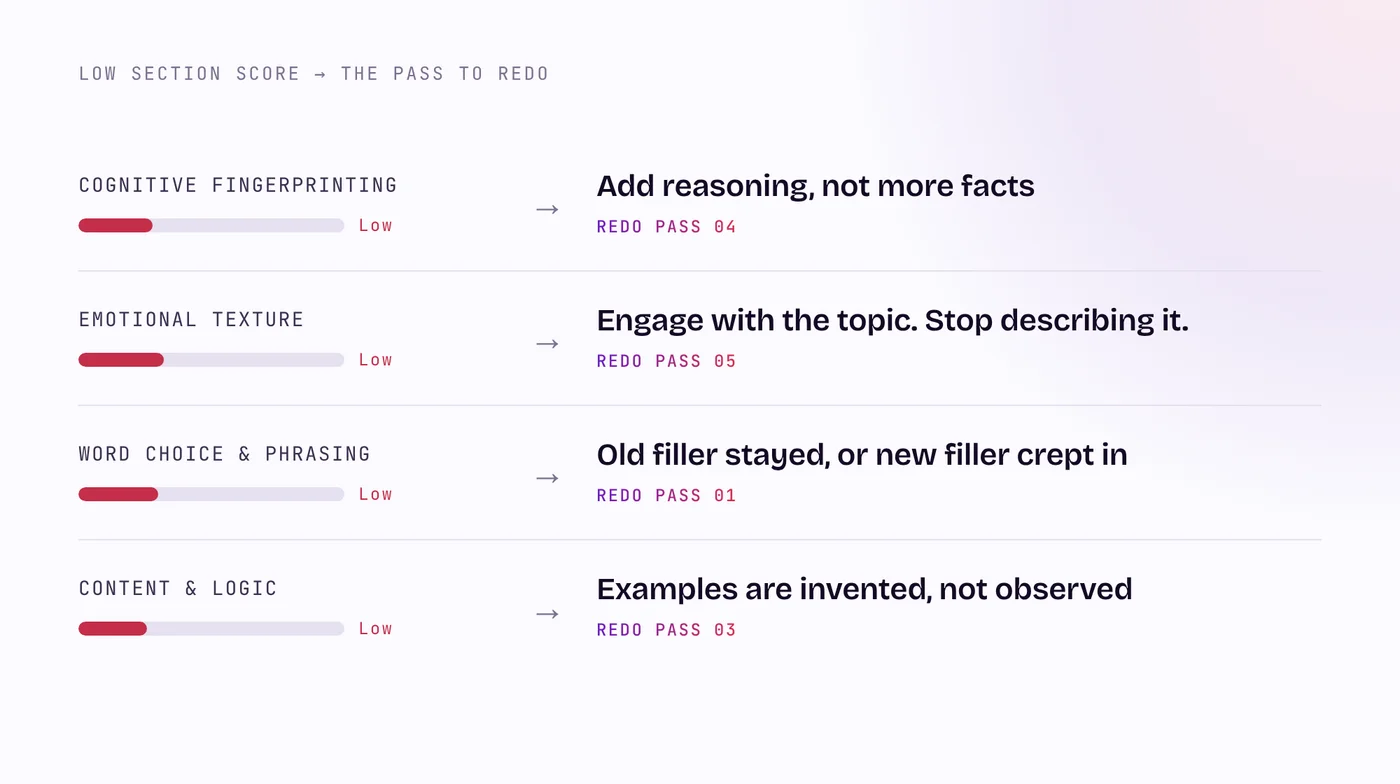
Low Cognitive Fingerprinting? The piece still presents information instead of working through it. Low Emotional Texture? It's still detached, describing the topic from across the room. Low Word Choice? The filler pass wasn't thorough, or old filler got swapped for new filler (it happens more than you'd think). Low Content & Logic? The examples are still illustrations, not specifics.
The scores are a diagnostic. They aren't a verdict. The overall Human Score matters much less than which sections are dragging it down, since those sections point to the editing work that's left.
"The AI draft saved you from staring at a blank page. That's valuable. But the work is the edit. Don't skip the work."Colin H · Web Thrive
Done properly, this takes longer than publishing the draft as is. That's the point. The AI draft solved the blank page, which is one of the hard parts of writing. The other hard part is making the writing worth reading, and that part still belongs to the person whose name goes on it.
Frequently asked questions
For the deeper reasons these signals matter, Why AI Writing Sounds Different covers the cognitive patterns behind them. How AI Text Detection Actually Works explains what Content Trace measures when it scores a piece. And The Specificity Test goes further into Pass 3.
Colin H builds ContentTrace at Web Thrive. He has spent 20+ years in B2B SaaS marketing, running content, SEO and AEO programs, and now builds them around AI-assisted content production. Read the ContentTrace manifesto