Brand Voice Guides That AI Can Actually Follow
- →Most brand voice guides are lists of adjectives, and a model can only map adjectives onto its own default style.
- →Nielsen Norman Group's four tone dimensions give a guide something a model can act on: a set position on each dial.
- →Every trait in the guide should become a rule a reader could check, such as a sentence length target or a banned category of phrase.
- →Paired examples teach voice faster than descriptions. Show the same message on-voice and off-voice.
- →Voice stays fixed and tone shifts with the situation. A guide that doesn't separate the two produces a cheerful apology email.
- →A voice guide is finished only after it has been tested on the model and its misses have been fixed.
Mailchimp's content style guide describes its voice in four short lines. "We are plainspoken. We are genuine. We are translators. Our humor is dry." It's one of the best-known voice guides on the web, and for human writers it works, because the rest of the guide is full of examples, explanations and pages of specific rules.
Now picture what happens when a team copies only the summary into a prompt. Take a hypothetical brand whose guide says "friendly, clear, confident, human." The model reads four adjectives and does its best, which means producing its own default idea of friendly and confident. That default is the voice every other brand gets too.
Every voice guide in the industry seems to describe the same company: friendly, clear, confident and human. Rarely has one personality been licensed so widely. A model can't tell those brands apart, because their guides don't.
Formal or casual, serious or funny, respectful or irreverent, matter-of-fact or enthusiastic.
Why adjective lists fail with models
An adjective is a summary of many decisions. "Plainspoken" means short sentences, everyday words, no jargon without a translation, and a preference for naming the thing over naming its category. A human writer who reads the full guide learns those decisions from the examples. A model given only the word has to guess them, and its guess is the average.
The obvious fix is to add more adjectives, or stronger ones. "Very casual. Witty. Bold." It doesn't work, because stronger adjectives just push the model further into its own idea of those words. Ask for "witty" and you tend to get puns and exclamation marks. Ask for "bold" and you get "Let's be honest" at the top of every second paragraph. The result is louder and still generic.
Anthropic's prompting guide has a useful line on this: "Providing context or motivation behind your instructions ... can help Claude better understand your goals." Its example replaces "NEVER use ellipses" with an explanation that the text will be read aloud by a text-to-speech engine. The reason does the work. A voice guide that explains why the brand writes the way it does gives the model something to generalize from.
Set the dials before writing any rules
Nielsen Norman Group offers the cleanest starting point. Kate Moran's article on the four dimensions of tone of voice breaks tone into formal versus casual, serious versus funny, respectful versus irreverent and matter-of-fact versus enthusiastic. In NN/g's study, changes along those dimensions produced measurable differences in how users saw a brand. A funny, casual insurance sample came across as friendlier and less formal than a serious one.
The surprising part is how small the gaps were. Rating differences ran about half a point to a point on a five-point scale, in a survey of 50 people. Small shifts in tone still moved impressions in a measurable way. That's a good argument for setting the dials precisely, since a model drifting one notch toward enthusiastic will change how the brand reads.
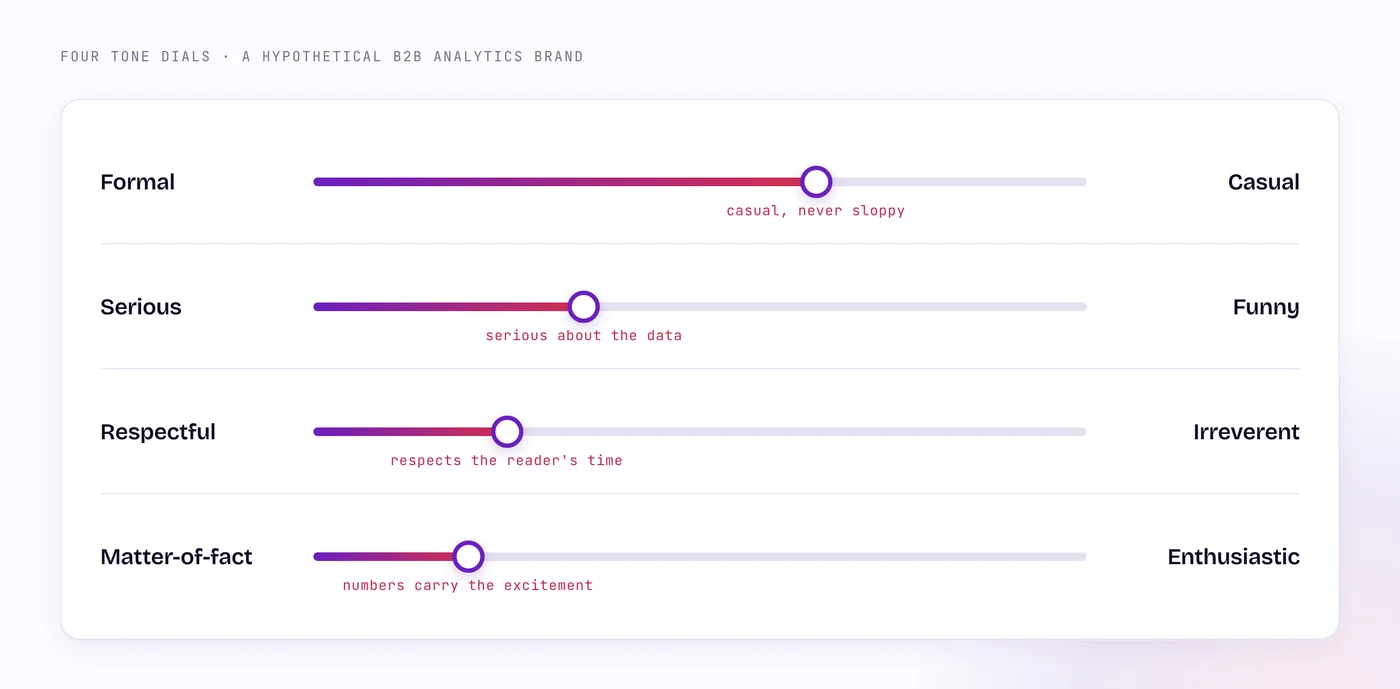
Write the position as a sentence the model can use. For a hypothetical B2B analytics brand: "Casual but never sloppy. Serious about the data, light about everything else. Respectful of the reader's time. Matter-of-fact: let the numbers carry the excitement." Four sentences, and each one rules out a whole family of bad drafts.
Turn every trait into a rule someone could check
Here's the test for each line of the guide: could two editors disagree about whether a paragraph follows it? If yes, it's still an adjective. Rewrite it until a reader, or a model, could check it on the page.
Phrase each rule as something to do. Anthropic's guide says it directly: "Tell Claude what to do instead of what not to do." Banned-word lists still have a place, but keep them short and attach a replacement to each item. "Instead of 'leverage,' name the action: use, connect, cut."
Show the voice in pairs
Descriptions tell the model where to aim. Examples show it what a hit looks like. Anthropic's guide says "a few well-crafted examples" improve accuracy and consistency, recommends three to five, and asks for examples that are relevant and varied enough that the model "doesn't pick up unintended patterns."
For voice, the most useful format is a pair: the same message written on-voice and off-voice, with one line explaining the difference. A pair isolates the voice from the content, so the model learns the voice instead of the topic. Mailchimp's guide contains the human version of this in a single sentence: "We're weird but not inappropriate, smart but not snobbish." That line is the most model-friendly sentence in the whole guide, because each half names both the target and the miss.
Pick examples from different formats. If all three come from blog posts, the model learns blog-post habits and carries them into email. There's a particular embarrassment in watching a carefully tuned launch-post voice turn up, exclamation marks intact, in a billing-error notice to a customer who is already annoyed.
Separate voice from tone
That billing email is a tone failure, and Mailchimp's guide explains the distinction better than most.
"Our voice doesn't change much from day to day, but our tone changes all the time."Mailchimp Content Style Guide · Voice and tone
For a model, that means two layers. The voice layer holds the dials and rules that never move. The tone layer is a short table of situations, each with its own adjustment: product launch (more enthusiastic, still matter-of-fact about numbers), error or outage (serious, no jokes, lead with what happened and what to do), help article (plain, no personality beyond clarity). Paste the voice layer into every prompt and the matching tone row for the job at hand.
Test the guide on the model and keep a miss log
A voice guide written for people is usually approved in a meeting and never tested. A guide written for a model can be tested in ten minutes, so test it. Give the model three different jobs with the guide attached and read each output against the rules, line by line.
Log every miss. Each one means a rule was vague, an example was missing or two rules conflicted. Fix the guide and run the same jobs again. After a few rounds, the misses get rarer and more interesting, which is how you know the guide is converging on something real.
A diagnostic helps with the misses that are hard to name. Content Trace explains its Human Score with 32 signals in 8 sections. It doesn't know your brand rules, but a weak Voice & Perspective or Word Choice result usually marks the passages where the model slid back into its default voice. Those passages show which rule to tighten next.
The payoff goes beyond the model. A guide built from dials, checkable rules and paired examples is also the guide a new freelancer needed all along.
Frequently asked questions
A voice guide is one part of a good brief, and Prompting for a Better First Draft covers the rest. The Generic Middle shows where voice usually fades in a long draft. And Why AI Writing Sounds Different explains the default voice that every vague guide falls back to.
Colin H builds ContentTrace at Web Thrive. He has spent 20+ years in B2B SaaS marketing, running content, SEO and AEO programs, and now builds them around AI-assisted content production. Read the ContentTrace manifesto