Google Is Fine With AI-Assisted Content. Readers Are the Harder Audience
- →Google Search Central says generative AI can be useful for research and for adding structure to original content. Using AI is not the problem.
- →The line Google draws is scaled content abuse: many pages generated mainly to manipulate rankings, without adding value for users.
- →Google's required review is wider than most teams think. It covers titles, meta descriptions, structured data and alt text, as well as the body.
- →Readers are the stricter audience. In Raptive's 2025 survey, content people believed was AI-generated was rated 48% less trustworthy.
- →The reader penalty is triggered by suspicion, so generic writing pays it whether a person or a model wrote it.
- →Google's own self-assessment questions are really reader questions. Edit to them and both audiences are covered.
Google's guidance page on generative AI content contains a sentence that a lot of nervous content teams have never read: "Generative AI can be particularly useful when researching a topic, and to add structure to original content." That's Google Search Central, in its own documentation, describing AI as a useful tool.
Now put that next to a survey Raptive published in August 2025. Three thousand US adults reviewed similar human-written and AI-generated content. When people believed a piece was AI-generated, they rated it 48% less trustworthy, 57% less authentic and 60% lower on emotional connection.
Those two facts describe two different audiences. One of them has written down, in public, what it wants. The other one hasn't, and it's far less patient. Teams that spend their energy worrying about the first are guarding the wrong door.
Raptive survey of 3,000 US adults, August 2025. The penalty follows suspicion, not proof.
What Google actually says about AI-assisted pages
Google's position is calmer than the forum threads suggest. Its guidance on using generative AI content says AI is useful for research and structure. It warns that generating many pages without adding value for users may violate the spam policy on scaled content abuse. And it asks for one thing in between: "It is critical to manually factcheck and review all AI-generated content for accuracy and trustworthiness before publishing."
The detail that most teams miss sits in the next line. That review "also applies to metadata like <title> elements, meta description elements, structured data," and image alt text. In practice, those are the fields nobody reads twice. A writer edits the body for an hour, then pastes in a model-written meta description and twelve alt attributes without looking at them. Google named them on purpose.
There's a second detail for anyone in ecommerce. The same page says AI-generated product data, such as title and description attributes, must be specified separately and labeled as AI-generated. That rule applies to merchant product data, not to blog posts, but it shows how specific Google gets when it wants a label. For articles it asks for something softer.
Where Google draws the line: scale without value
Google's spam policies define scaled content abuse as many pages "generated for the primary purpose of manipulating search rankings and not helping users." The first example on the list is "using generative AI tools or other similar tools to generate many pages without adding value for users." The list continues with scraping feeds, stitching content together from other pages and building networks of sites to hide the scale.
The easy reading is that Google is coming for AI. Read the policy again, though, and the tool is almost incidental. Scraping and stitching are on the same list, and plenty of that was done by hand long before any chatbot existed. The violation is a purpose (rankings over people) combined with a pattern (many pages, little value). One careful AI-assisted guide matches neither.
That's a relief for most writers, and it should be. It also removes a convenient excuse. If Google isn't the obstacle, then a page that fails has failed with readers, and that's harder to blame on an algorithm update.
Readers punish suspicion, and they don't wait for proof
The most useful line in the Raptive study is a quiet one. Anna Blender, Raptive's SVP of data strategy and insights, put it this way: when people thought something was AI-generated, they rated it worse. Thought. The penalty attaches to the reader's belief, and the belief forms early, from style.
"When people thought something was AI-generated, they rated that content much worse across metrics like trust and authenticity."Anna Blender · Raptive, 2025
Here's the surprising part. Because the trigger is suspicion, a human writer with a flat, hedged, list-heavy style pays the same tax as an unedited model. There's a particular sting in that for anyone who has written every word of a piece by hand and then watched a reader call it ChatGPT in the comments. What readers are really reacting to is writing that sounds like nobody in particular.
The cost doesn't stop at trust either. Raptive also measured the ads next to the content: purchase consideration fell 14%, and so did willingness to pay a premium. Google, it turns out, is the easy reader. It has published its criteria and it doesn't get bored.
Google's own questions are reader questions
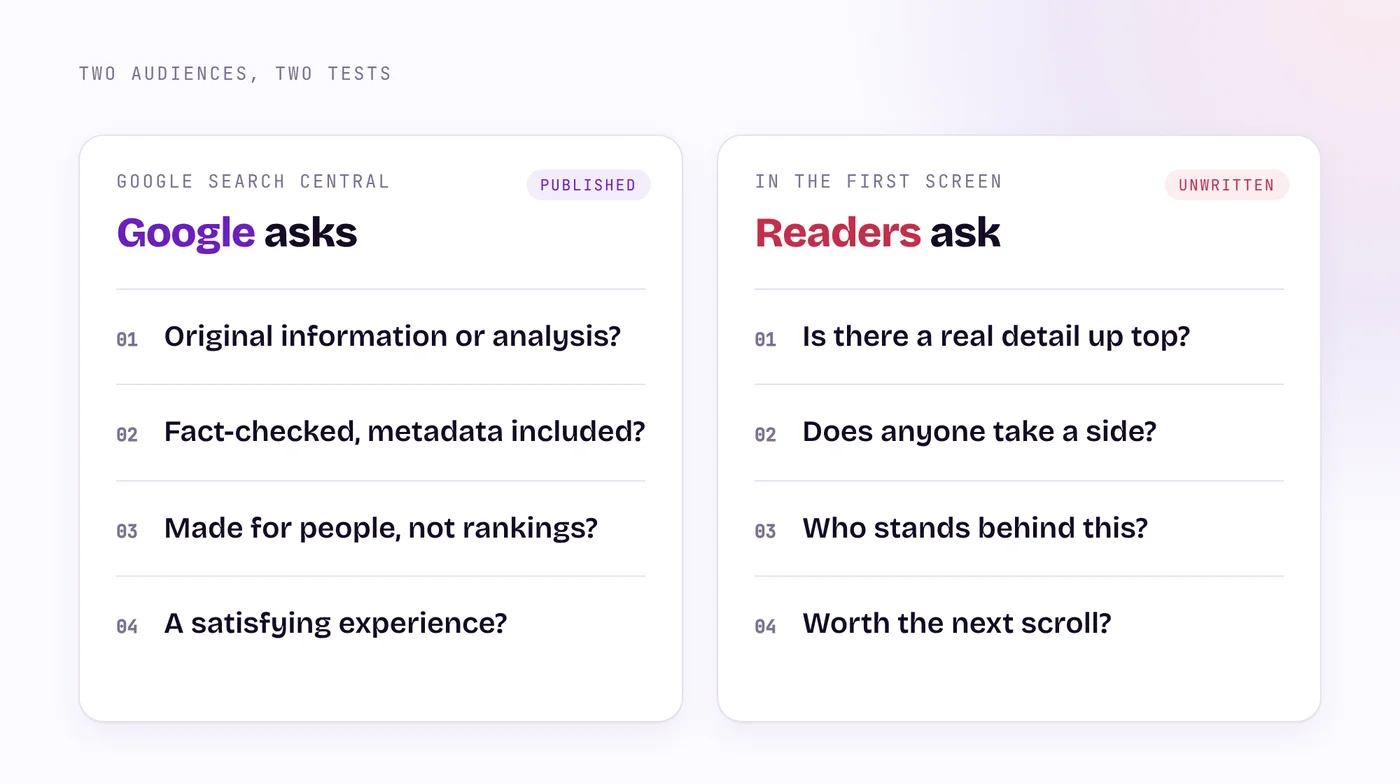
Look closely at Google's guide to creating helpful, reliable, people-first content and something odd stands out. Very few of its self-assessment questions are about search. "Does the content provide original information, reporting, research, or analysis?" "After reading your content, will someone leave feeling they've learned enough about a topic to help achieve their goal?" "Will someone reading your content leave feeling like they've had a satisfying experience?"
Those are the questions a good editor asks. The warning signs on the same page read the same way: content made mainly to attract search visits, extensive automation across many topics, and "mainly summarizing what others have to say without adding much value." The last one is the trap a raw AI draft falls into by default, because a model with no input from you can only summarize what's already out there.
Then there's the "Who, How, and Why" section. Google asks whether the use of automation, including AI generation, is self-evident to visitors, and suggests adding disclosures "when it would be reasonably expected." It doesn't demand a banner on every page. It asks you to think about what your reader would want to know. And the "why" carries the weight: content should exist mainly to help people who visit your site directly.
What an AI-assisted page needs before it ships
Put both audiences together and the editing job gets clear. Google's minimum is accuracy, a full review that includes metadata, and a reason for the page to exist. The reader's minimum is higher: a reason to believe a specific person with specific knowledge stands behind the words.
A workable pre-publish pass looks like this. Fact-check every claim and number against a source you can open. Read the title, meta description and every alt attribute as if they were body copy, since Google says they are part of the review. Find the one detail on the page that a competitor's article couldn't contain. If it doesn't exist, add it or don't publish yet.
Decide on disclosure page by page, using Google's own test of what a reader would reasonably expect. Take a hypothetical comparison of two project-management tools. A reader assumes someone actually used both, so a short note on how the comparison was done earns trust. A glossary entry drafted with AI and checked by a specialist rarely needs the same note. Blanket rules in either direction end up wrong for a lot of the pages they touch.
One more check catches a surprising number of problems: ask who would be embarrassed if the page were wrong. If the answer is nobody, because no named person or team stands behind it, the page has no owner. Readers notice ownerless pages quickly, even when they can't say what's missing.
Then read the first screen the way a skeptical stranger would. Does it open with a fact or a scene, or with a definition the reader already knows? Is there a sentence that takes a side? Hedged openings are where suspicion starts, and once it starts, Raptive's numbers say it colors everything after.
This is where a diagnostic helps more than a gut check. Content Trace explains its Human Score with 32 signals in 8 sections, so a low score points at a specific weakness: filler phrases, missing specifics, opinions that never commit. Treat the score as a map of the edit that's left. It isn't a verdict on whether you used AI, and it can't promise a ranking. Nothing can.
The teams that do well with AI-assisted content have mostly stopped asking whether Google will allow it. Google answered that in writing. The live question is whether a reader who has never heard of you will trust the page enough to keep going, and that one gets answered in the first ten seconds, every time.
Frequently asked questions
For the search side in more depth, AI Detection and SEO looks at what Google rewards. The Specificity Test shows how to find the detail only your team could add. And How to Humanize AI Content walks through the full editing pass.
- Google Search Central: Google Search's guidance on using generative AI content on your website
- Google Search Central: Spam policies for Google web search (scaled content abuse)
- Google Search Central: Creating helpful, reliable, people-first content
- Raptive: The "AI stink" is real, and it's costing brands (August 2025)
Colin H builds ContentTrace at Web Thrive. He has spent 20+ years in B2B SaaS marketing, running content, SEO and AEO programs, and now builds them around AI-assisted content production. Read the ContentTrace manifesto