How to Add Real Expertise to an AI Draft (Without Inventing Any)
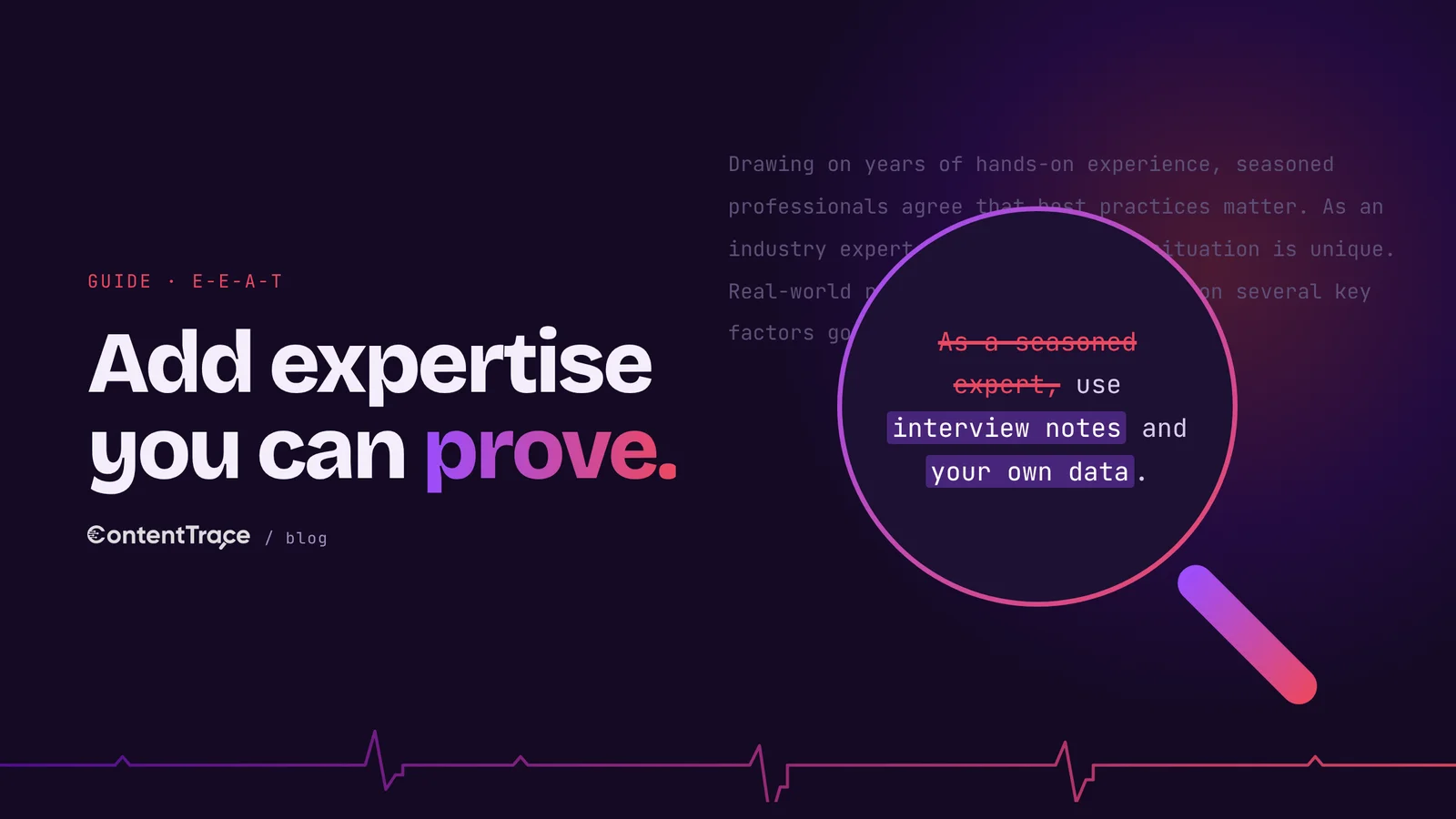
- →A model can give an AI draft structure, but it can't give it the first E in E-E-A-T. Experience has to come from a person who did the work.
- →Prompting a model to "write from experience" doesn't add experience. It produces a convincing memory that belongs to nobody.
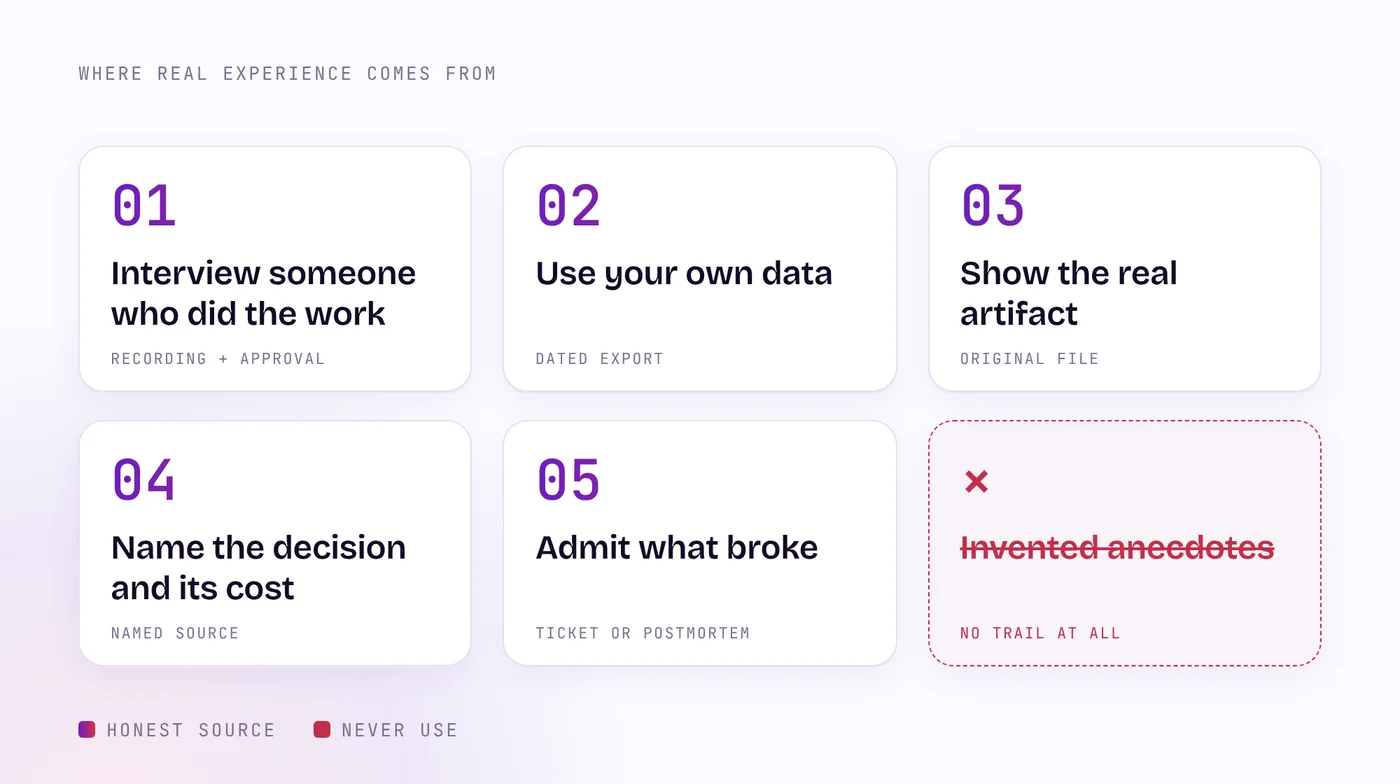
- →Five honest sources cover almost every post: an expert interview, your own data, real artifacts, the decisions you made and the things that broke.
- →Have the draft leave bracketed gaps where experience belongs, then fill each gap from a real source or delete the sentence.
- →Google's rater guidelines put Trust at the center of E-E-A-T, so one invented anecdote costs more than it could ever earn.
- →Before publishing, every experience claim should point to proof on file: a recording, an export, a screenshot or a ticket.
Google's search quality rater guidelines contain a test anyone can run in their head. Which would you trust: a product review from someone who has personally used the product, or one from someone who hasn't? Nobody hesitates. What's less obvious is what happens when an AI draft is asked to supply the first kind of review.
It supplies it. Cheerfully. Ask a model to "add personal experience" to a post about switching CRMs and it will describe the migration weekend, the import that failed at row 4,000 and the sales lead who finally came around. None of it happened. The prose is good. That's the problem.
This guide covers the other route: putting real expertise into AI-assisted drafts, from people who have it, with proof on file. It's slower than asking the model. It's also the only version of E-E-A-T that survives a reader asking, "Which project was that?"
None of them asks the model to invent a single detail.
Why a model can't supply the first E
The rater guidelines define Experience in one plain sentence: "the extent to which the content creator has the necessary first-hand or life experience for the topic." Read it twice. The sentence is about the creator, not the text. A model has read about thousands of CRM migrations and run none of them.
Google's helpful content guidance says the same thing from the publisher's side. It asks whether content shows "expertise that comes from having actually used a product or service, or visiting a place." A model can't visit anywhere. It's generous with anecdotes anyway, and judging by its drafts, it has attended every industry conference ever held.
None of this makes AI the wrong tool. Google's guidance on generative AI says it "can be particularly useful when researching a topic, and to add structure to original content." Notice the last two words. The structure can come from the model. The original part has to come from somewhere else, and that somewhere is a person.
The obvious fix is a better prompt: "Write as a senior engineer with 15 years of experience." It doesn't work, because the model takes the role seriously and delivers exactly what was asked for, a believable memory with no owner. The prompt didn't add experience. It added a costume.
Five sources of real expertise, from cheapest to richest
Almost every post can draw on at least two of these. None needs a research budget. Each one needs a person to go and get something the model doesn't have.
1. Interview someone who did the work
Most companies already employ the experience their drafts are missing. It sits with support leads, implementation engineers, sales engineers and the account manager who hears the same objection every week. A recorded 20-minute call usually holds more usable material than a week of prompting.
Skip "What are the best practices?" That question gets the website back, read aloud. Ask "What did you get wrong the first time?" and "What do customers ask that the docs don't answer?" The best material tends to arrive after the official answer, once the expert relaxes and starts talking the way they'd talk to a friend. Keep recording through the small talk at the end. That's where the good line usually is.
Then give the transcript to the model as source material and tell it to quote only what's in the transcript. Send every quote back to the expert for approval before it goes live. That one email prevents a very awkward conversation later.
2. Use your own data
Exports, ticket counts, analytics, sales notes. Small numbers are fine. Take a hypothetical help desk: "Of the last 30 tickets tagged billing, 11 were about proration" is a sentence no competitor can copy, and no model can produce, because the number lives in one system. That's the core of information gain. Keep the export, with its date, in the same folder as the draft.
3. Show the artifact
A screenshot of the real settings screen. A config snippet. A redacted brief. A before and after of a page that was actually changed. Artifacts do two jobs. Readers trust what they can see, and the writer gets a quiet reminder that the thing happened. It's hard to accidentally fabricate a screenshot.
4. Name the decision and what it cost
AI drafts list options. People who have done the work pick one and say what it cost them. That trade-off is the clearest mark of experience a post can carry, and it's exactly what a model leaves out, because it has never had to live with a choice.
The edited version only works if an ops lead really said it. The example above is hypothetical and labeled that way. On a live page, that sentence needs a name and a recording behind it.
5. Admit what broke
Failures are the most credible material a post can hold, and a model never offers them unprompted. Anyone who has watched a launch email go out with a broken merge tag knows the particular heat in the face that follows the first reply. That memory is expertise. It also tells readers what to check, which is more useful than another list of tips.
Mark the gaps before you fill them
The cleanest workflow starts at the prompt. Tell the model to leave a bracketed placeholder wherever experience belongs, something like [EXPERIENCE: a real example of a failed import], instead of making one up. Prompting for a better first draft covers how to set that up. The draft comes back with its weak spots labeled.
Then a person fills each placeholder from one of the five sources, or deletes the sentence. Both outcomes are fine. A placeholder nobody can fill is useful information: the team may not own this topic yet.
One pattern shows up fast. The placeholders bunch together in the middle of the draft, where the model's examples go soft and its advice turns into lists. That's the same stretch described in the generic middle of AI drafts, and it's where an hour of interview material does the most good.
Where trust breaks in AI-assisted drafts
Here's the part that should change how teams think about this. The rater guidelines say "the most important member at the center of the E-E-A-T family is Trust," and that "untrustworthy pages have low E-E-A-T no matter how Experienced, Expert, or Authoritative they may seem."
Google's helpful content page adds a detail that surprises people: content "doesn't necessarily have to demonstrate all of" the E-E-A-T aspects. So an invented anecdote trades away the one quality Google calls essential to fake one it calls optional. Few trades in content marketing are that bad, and that's a field with a lot of competition for the title.
"An invented anecdote spends the one thing E-E-A-T can't do without to buy something it can."Content Trace · Voice & Perspective Signal
Put bluntly: if nobody on the team did the thing, don't write as if somebody did. Attribute the experience to the person who has it, by name, or write the piece as an honest research summary with its sources showing.
Real expertise also makes disclosure easy. Google's guidance asks whether "the use of automation, including AI-generation" is "self-evident to visitors through disclosures or in other ways," and suggests adding that context when readers would reasonably expect it. A line saying AI helped structure the post and a named support lead supplied the examples is honest. It also reads well. As Google is fine with AI-assisted content argues, the tool was never the issue.
Run a provenance check before you publish
The last pass is short and a little tedious. Go through the draft and find every sentence that claims experience: a quote, a number, a "the team tried," a screenshot. Each one should point to something on file.
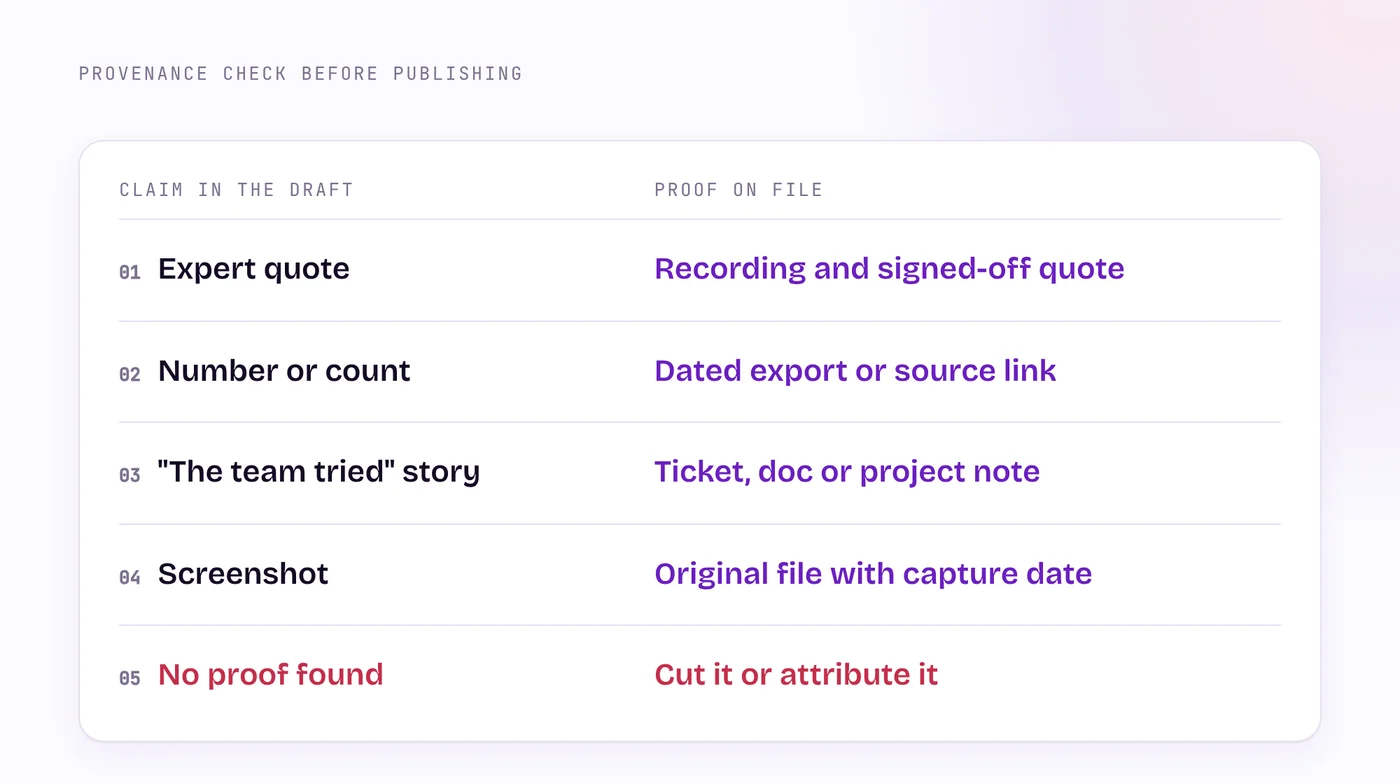
The dread this prevents is very specific. It's the moment a client's product lead reads the post, replies to the thread and asks which test a number came from, and the only honest answer is a chat window. Nobody forgets that afternoon. A provenance check takes far less time than the apology.
After the check, a Content Trace report is a useful second read. If Insider/Niche Knowledge or Personal Anecdotes Present still comes back low, the draft has gaps that the edit missed. Treat the score as a pointer to the paragraph that needs a real detail, then go and get one from a person. The model already did its part.
Frequently asked questions
For the search side of this argument, Information Gain: The SEO Edge an AI Draft Cannot Copy explains why original material matters for rankings. The Specificity Test shows how to spot the generic sentences that need a real detail. And Brand Voice Guides That AI Can Actually Follow covers the other half of making a draft sound like the people behind it.
Colin H builds ContentTrace at Web Thrive. He has spent 20+ years in B2B SaaS marketing, running content, SEO and AEO programs, and now builds them around AI-assisted content production. Read the ContentTrace manifesto