Writing for AI Overviews: How Passages Get Quoted
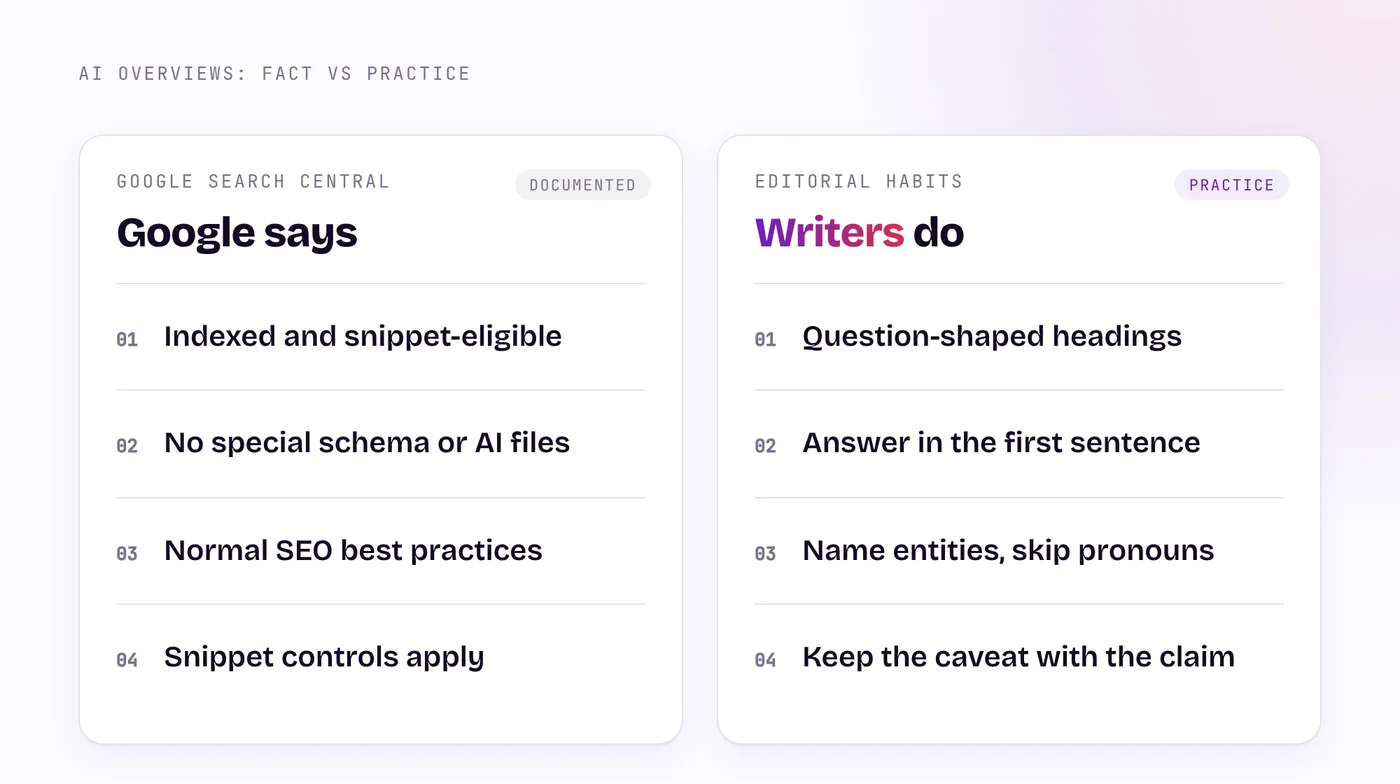
- →Google's own documentation says AI Overviews need no special markup, schema or AI text file. A page must be indexed and eligible for a snippet. That's the whole official list.
- →Everything beyond that list is practice, not documented fact. Treat any vendor who promises a guaranteed AI Overview placement with suspicion.
- →The passages that get quoted tend to answer one question in the first sentence and still make sense when lifted out of the page.
- →Named entities beat pronouns. A paragraph that starts with "This" or "As mentioned above" can't stand alone, so it's hard to quote.
- →AI drafts already produce answer-shaped structure. What they can't supply is the specific detail that makes one answer worth citing over fifty similar ones.
Google's page on AI features in Search, last updated in December 2025, contains one sentence that a whole cottage industry would prefer you skip: "There are no additional requirements to appear in AI Overviews or AI Mode, nor other special optimizations necessary." A few lines later it adds that you don't need new machine-readable files, AI text files or markup, and that there's no special schema.org structured data to add.
That's awkward for anyone selling an "AI Overview schema package."
It's good news for writers, though. If no technical trick gets a page quoted, the lever left is the one writers actually control: the passage itself. This post covers what Google officially says, then the writing habits that tend to separate the paragraphs AI answers lift from the ones they skip. The second part is practice, and it's labeled that way.
Per Google Search Central. The page has to be indexed and snippet-eligible. The rest is the writing.
What does Google officially say about ranking in AI Overviews?
Less than most people expect, and all of it is short. According to Google Search Central, a page needs to be indexed and eligible to be shown in Google Search with a snippet. There are no additional technical requirements, and indexing and serving aren't guaranteed. The best practices Google lists are ordinary SEO: allow crawling, use internal links, give a good page experience, keep important content in text form, and make structured data match the visible text.
Two mechanics in that documentation matter for writers. First, AI Overviews and AI Mode may use a technique Google calls query fan-out, issuing multiple related searches across subtopics to build one response. A single answer can draw on many pages, each covering one slice of the question. Second, AI Overviews appear only when Google's systems decide they add something to classic Search. Plenty of queries never trigger one.
Google has also made a traffic claim since launch. In the May 2024 announcement, Elizabeth Reid, VP of Search, wrote that links included in AI Overviews get more clicks than if the page had appeared as a traditional web listing for that query. The current AI features page says clicks from AI Overviews are higher quality, with people spending more time on the site. Those are Google's statements about Google's product. Read them as such.
One insider detail worth knowing: AI features use the same preview controls as regular snippets. A data-nosnippet attribute, a low max-snippet value or a nosnippet rule limits what can appear. Teams sometimes add data-nosnippet to a pricing block or a disclaimer for legal reasons and forget it's there. If that block holds the clearest answer on the page, it's off the table.
Why do some passages get quoted and others don't?
Google doesn't publish a passage-selection rubric, so nobody outside Google can give a full answer. What follows is practice: patterns that line up with how Google describes the system and with how featured snippets have always behaved. Google's featured snippets documentation makes the same point bluntly. Asked how to mark a page as a featured snippet, the answer is: "You can't." Automated systems decide.
If fan-out searches subtopics, each subtopic needs a passage that answers it cleanly. Picture the system holding one paragraph from your page and nothing else. Does that paragraph say what it's about? Does it contain the answer, or only point toward it? Does it lean on a sentence two paragraphs up?
The obvious fix is to make every paragraph shorter. It doesn't work, because short isn't the same as self-contained. A 30-word paragraph that opens with "This is why" is just as stuck to its neighbors as a 200-word one. The real fix is to make each paragraph carry its own subject and its own answer, at whatever length the idea needs.
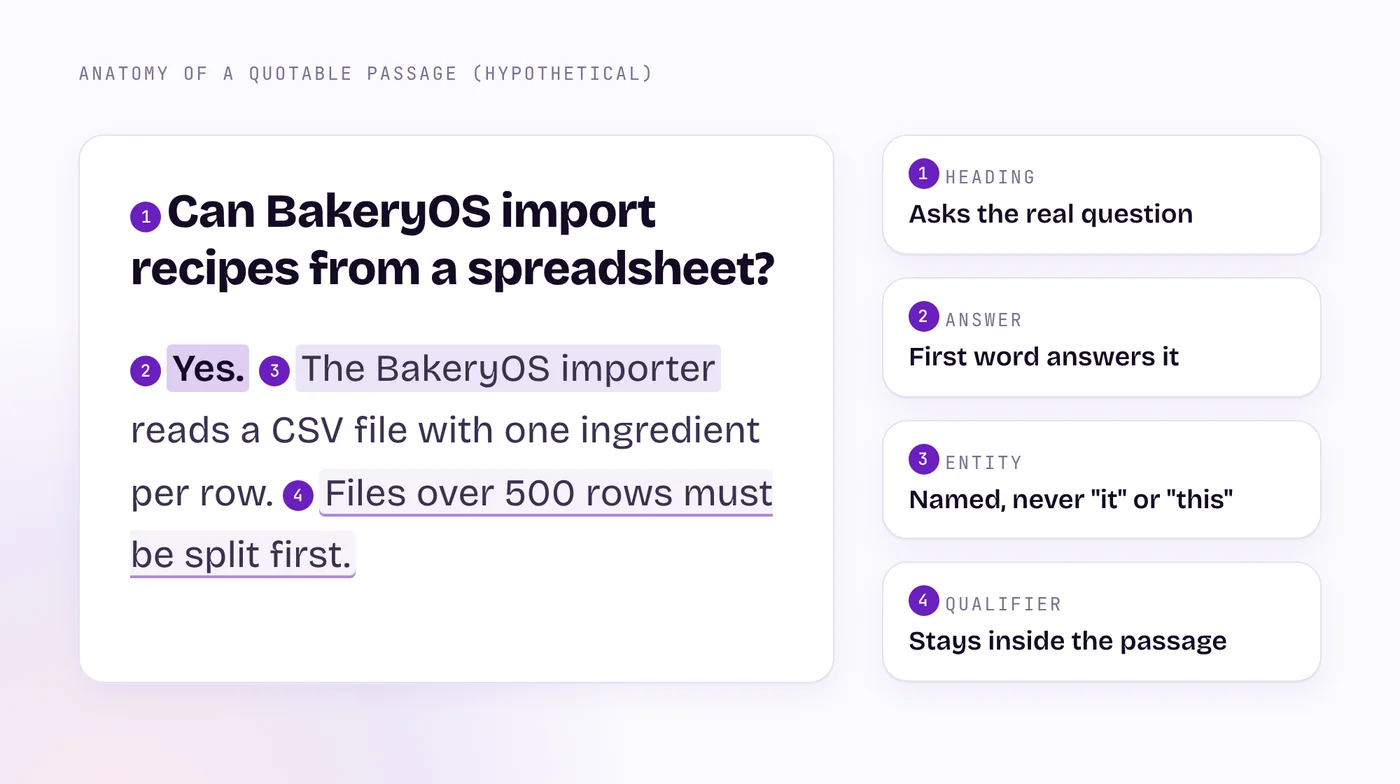
Three habits do most of the work. Put the answer in the first sentence, then the detail. Name the subject instead of pointing to it. Keep the qualifier inside the same passage as the claim, so a lifted quote doesn't become a wrong one. That last habit is the one people skip, and it's the one that protects you when your words show up somewhere you didn't write them.
The left passage isn't wrong. It just never answers the question, and it never says which product it means. The right one could be pasted into any AI answer and still be true and complete, including the limit that keeps a reader out of trouble.
How do you write an answer-first passage?
Start with the heading. Google's helpful content guidance asks whether the main heading or page title gives a descriptive, helpful summary of the content. Question-shaped H2s do that well, because they match how people type and speak queries. "Pricing" tells a reader very little. "How much does the Pro plan cost per seat?" tells them, and the system, exactly which question the next paragraph answers.
Then answer it in the first sentence under the heading. Yes, no, a number, a name, a date. The context comes second. Writers trained on essays find this physically uncomfortable, because it feels like giving away the ending in the first line. It is. That's the job.
After the answer, add the one detail that makes the passage yours: the threshold, the exception, the version number, the case where the answer flips. Then stop. A passage that answers, qualifies and stops is easier to lift than one that wanders into the next subtopic.
"A passage that answers, qualifies and stops is easier to lift than one that wanders into the next subtopic."Content Trace · Content & Logic Signal
Why do named entities matter more than keywords?
A keyword tells a system what a page is about. An entity tells it what a sentence is about. Pronouns erase entities. "It updates daily" is meaningless out of context. "The Search Console Performance report updates daily" can stand anywhere. That's the reason to repeat the name of the thing more often than a style guide from 2005 would like.
The same goes for numbers and sources. A statistic that floats free ("studies show 70% of users...") is weak on a page and weaker in an answer, where it arrives with no context at all. Put the source in the sentence. Name the year. If the number comes from internal data, say so in the same breath.
Where do AI drafts help, and where do they fall short?
Here's the surprising part. The format AI-assisted writers worry about most is the part a model handles best. Ask any capable model for a question heading and a direct answer and you'll get one in seconds, neatly structured. Answer-first structure is cheap now.
That's exactly why it stopped being enough. When fan-out pulls passages for a subtopic, it finds many pages that answer the same question in nearly the same words, because many of them came from similar prompts. Fifty versions of the consensus give a system no reason to prefer yours. The passage that wins usually has something the others lack: a real threshold, a named exception, a number from actual work, an opinion with a reason attached. Google's helpful content guidance asks for this directly, with questions about original information and "substantial value when compared to other pages in search results."
There's a particular irritation in finding an AI answer that quotes a competitor saying exactly what your page says, only plainer and three paragraphs higher. That's usually a structure problem, and it's fixable. Losing to a page that simply knows more is a content problem, and no amount of formatting closes that gap.
So use the draft for what it's good at. Let it propose the question headings and the first-pass answers. Then do the human part: check every answer for accuracy, add the detail only your team knows, name the entities, and keep the caveat next to the claim. Content Trace explains its score with 32 signals in 8 sections, and the specificity and insider-knowledge signals are a fair proxy for whether a passage has anything worth quoting. Pretty formatting won't move them. Real information will.
Frequently asked questions
For Google's wider stance on AI-assisted pages, read Google Is Fine With AI-Assisted Content. Readers Are the Harder Audience. The Specificity Test covers how to find the detail that makes a passage worth quoting. And The Generic Middle explains why AI drafts lose their specifics right after the intro, which is where most answer passages live. A passage only gets quoted if it says something new, which is the point of Information Gain, and How to Add Real Expertise to an AI Draft shows how to supply that material honestly.
Colin H builds ContentTrace at Web Thrive. He has spent 20+ years in B2B SaaS marketing, running content, SEO and AEO programs, and now builds them around AI-assisted content production. Read the ContentTrace manifesto